
Description
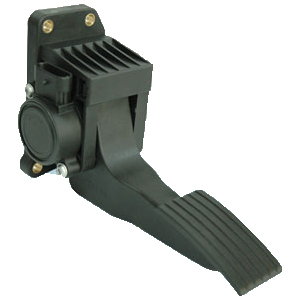
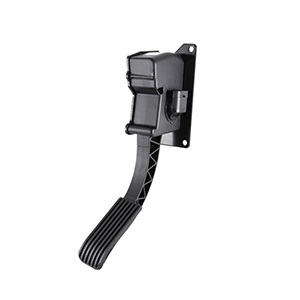
Williams Controls WM-554 Electronic Suspended Pedal – Hall-Effect Electronic Throttle Control
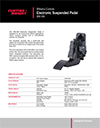
The Williams Controls WM-554 Electronic Suspended Pedal is a compact and durable electronic accelerator designed for commercial and industrial vehicle applications. Combining non-contact Hall-effect sensing technology with an engineered plastic body and lever arm, a corrosion-resistant coated-steel mounting bracket and customisable mechanical geometry, the WM-554 provides Original Equipment Manufacturers with a versatile solution for electronic throttle control in demanding mobile equipment applications.
Designed as part of the Williams Controls electronic throttle control range, the WM-554 converts physical accelerator pedal movement into an electrical signal that can be interpreted by a compatible engine, motor or vehicle controller. This electronic drive-by-wire architecture removes the requirement for a traditional direct mechanical throttle connection between the accelerator pedal and the engine, providing vehicle designers with greater flexibility when developing modern commercial and industrial equipment.
The WM-554 incorporates a Hall-effect non-contact position sensor that can be programmed for analogue output. The standard product specification identifies a Dual Accelerator Position Sensor (Dual APS) output arrangement, providing two accelerator position signals for compatible electronic control architectures.
With a three-million full-travel cycle product life, approximately 19-degree angular rotation, progressive pedal force, IP67 sealed electronics and substantial environmental qualification, the WM-554 provides a strong combination of lightweight construction, mechanical durability and reliable electronic accelerator position sensing.
Designed for Commercial and Industrial Vehicle Applications
The Williams Controls WM-554 has been developed for commercial and industrial vehicles where dependable accelerator operation is required throughout demanding working conditions. These applications can expose operator controls to frequent pedal movement, vibration, temperature changes, humidity, dust and contamination over extended vehicle service lives.
Electronic accelerator controls used in these environments must perform two important functions. Mechanically, the pedal assembly must withstand repeated operator input and the loads generated during normal vehicle operation. Electronically, the position sensor must provide dependable accelerator information to the receiving controller throughout the specified operating environment.
The WM-554 addresses these requirements through a combination of engineered composite materials, non-contact Hall-effect sensing, environmental sealing and a durable mechanical architecture. Its compact suspended configuration also provides useful packaging flexibility for vehicle manufacturers developing commercial and industrial operator compartments.
Suspended Electronic Pedal Architecture
The suspended architecture of the WM-554 allows the accelerator assembly to be supported from the vehicle structure above the floor rather than requiring the primary throttle mechanism to be mounted directly to the floor.
This configuration can provide several advantages within commercial and industrial vehicle cabs. Maintaining relatively clear floor access can assist routine cleaning where dirt, dust and debris are regularly introduced through operator footwear. Suspended installation can also provide additional flexibility when arranging controls around the driver’s seat, brake pedal, steering system and surrounding vehicle structures.
The WM-554 differs from fixed-mount suspended pedal designs by providing greater mechanical adaptability. Both the lever arm and mounting bracket can be customised to suit customer requirements and help optimise driver ergonomics.
This capability makes the WM-554 particularly useful for OEM projects where a standard pedal sensing platform is required but the physical accelerator geometry needs to be adapted to a particular cab or vehicle design.
Customisable Lever Arm and Mounting Bracket
One of the defining characteristics of the Williams Controls WM-554 is its customisable mechanical architecture. Both the pedal lever arm and mounting bracket can be adapted to assist installation and optimise the relationship between the accelerator and the vehicle operator.
Commercial and industrial vehicle cabs can vary significantly in size and layout. Seat height, steering column position, brake pedal geometry, available footwell space and surrounding vehicle structures can all influence the ideal accelerator position.
The ability to customise the WM-554 lever and bracket allows OEM engineers to consider these factors during vehicle development rather than designing the complete operator environment around a single fixed pedal geometry.
Correct accelerator positioning can contribute to improved operator ergonomics, particularly in vehicles used for extended working shifts. Pedal location should provide comfortable access while maintaining sufficient clearance throughout the complete accelerator travel.
Hall-Effect Non-Contact Position Sensing
At the centre of the WM-554 electronic throttle control is a Hall-effect non-contact position sensor. Hall-effect technology allows the accelerator position to be measured electronically without relying on the sliding electrical contacts traditionally associated with potentiometer-based position sensing.
Conventional contact-type potentiometers typically measure position using a mechanical wiper moving across a resistive element. Repeated movement creates physical contact between the sensing surfaces, which can contribute to electrical wear over an extended number of operating cycles.
Hall-effect sensing uses changes in a magnetic field to determine accelerator position. This means the primary sensing elements do not need to physically rub against one another every time the pedal moves.
For an accelerator pedal that may experience millions of movements during its working life, this non-contact sensing principle provides an important durability advantage. It reduces electrical contact wear while supporting consistent electronic position measurement throughout repeated operation.
Dual Accelerator Position Sensor Output
The WM-554 is specified with Dual Accelerator Position Sensor output, commonly referred to as Dual APS. This arrangement provides two accelerator position signals for use by a compatible engine or vehicle control system.
Dual-channel accelerator architectures are commonly used where the receiving controller is designed to process more than one position signal. The controller can evaluate the signals according to its programmed monitoring, diagnostic and control strategy.
The use of Dual APS does not mean that every electronic throttle system uses identical electrical characteristics. Signal relationships and controller requirements can vary between applications, making correct product selection essential.
OEM engineers should therefore confirm the exact WM-554 configuration and corresponding controller requirements when incorporating the pedal into a new vehicle design or selecting a replacement for an existing application.
Three Million Full-Travel Cycle Product Life
The Williams Controls WM-554 is rated for 3,000,000 full-travel cycles. This cycle life supports its use in commercial and industrial vehicles where accelerator controls may be operated repeatedly throughout long working periods.
A full-travel cycle represents movement through the accelerator’s operating range and return. The number of cycles accumulated by a vehicle depends heavily on its operating profile. Equipment involving frequent speed changes or repeated manoeuvring can accumulate pedal movements substantially faster than vehicles operating predominantly at constant speed.
The three-million-cycle rating therefore provides OEM engineers with an important indication of the WM-554’s intended mechanical durability.
This mechanical endurance works together with Hall-effect non-contact sensing. While the accelerator assembly still contains moving mechanical components, the position sensor does not depend upon conventional sliding electrical sensing contacts for each pedal movement.
19-Degree Accelerator Pedal Travel
The WM-554 provides approximately 19 degrees of accelerator pedal angular rotation. Current Williams Controls technical documentation specifies 19 degrees of angular rotation, while the product overview describes the pedal as having a nominal 19.5-degree rotation.
This travel provides the physical movement required for the operator to progressively communicate changes in accelerator demand to the electronic control system.
Pedal travel is an important consideration during vehicle integration because it affects both operator ergonomics and mechanical clearance. The accelerator should provide sufficient movement for controlled modulation while avoiding interference with the vehicle floor, trim, adjacent controls or other cab structures.
When developing a WM-554 installation, engineers should therefore consider the complete pedal movement together with the selected lever geometry and mounting bracket configuration.
Progressive Accelerator Operating Force
The WM-554 provides progressive pedal resistance as the accelerator moves from idle towards full travel. The specified operating force, measured at 200 mm from the pivot point, is 17 N at idle and 35 N at full travel.
The increasing force provides mechanical feedback as accelerator demand increases. Rather than maintaining identical resistance throughout the complete movement, the pedal progressively becomes firmer as it approaches full travel.
Pedal force contributes to the overall operator interface. An accelerator must be light enough for comfortable repeated use while providing sufficient resistance to support controlled foot movement and progressive throttle demand.
The WM-554’s combination of approximately 19 degrees of angular travel and progressive 17 N to 35 N operating force provides a defined mechanical relationship that can be considered during cab and operator-control development.
667 N Static-Load Capability
The Williams Controls WM-554 has a specified static-load capability of 667 N measured at 200 mm from the pivot point. This rating provides an indication of the mechanical strength of the accelerator assembly beyond the forces required during normal pedal operation.
Commercial vehicle pedals can occasionally experience abnormal loads caused by operator movement, heavy footwear or unintended pressure within the footwell. Providing mechanical strength beyond normal operating force helps the pedal assembly withstand these conditions.
The static-load specification should not replace appropriate vehicle-side structural design. The mounting arrangement and surrounding vehicle structure must also be engineered to support the accelerator and the loads expected in the intended application.
Engineered Plastic Body and Lever Arm
The WM-554 uses engineered plastic for its body and lever arm. This material selection allows the pedal to combine mechanical strength with reduced component mass and corrosion resistance.
High-strength composite materials are particularly useful in mobile equipment because they can provide durable structural performance without requiring the heavier cast-metal architecture used in some alternative accelerator designs.
The foot treadle and body castings are specified as composite plastic, while the mounting structure uses corrosion-resistant plated or coated steel. This combination provides a lightweight pedal and lever assembly supported by a robust metallic mounting interface.
For OEM vehicle manufacturers, reduced component mass can contribute to efficient cab design while the corrosion-resistant material combination supports operation in commercial and industrial environments.
Corrosion-Resistant Steel Mounting Structure
While the primary WM-554 body and pedal components use engineered plastic, the mounting interface is manufactured from corrosion-resistant coated steel. This provides a strong structural connection between the accelerator assembly and vehicle.
The use of steel at the mounting interface complements the lightweight composite pedal structure by providing mechanical support where the assembly attaches to the cab.
Because the mounting bracket can be customised, the WM-554 can be adapted to different vehicle structures while retaining the core Hall-effect sensing and pedal architecture.
IP67 Sealed Electronics
Commercial and industrial vehicle controls may be exposed to dust, moisture and contamination throughout normal service. Operator compartments can collect debris introduced through footwear, while specialist equipment may operate in particularly dusty or wet environments.
The electronics within the WM-554 are sealed to IP67 in accordance with IEC 60529. This rating provides complete protection against dust ingress and protection against temporary water immersion under the conditions defined by the standard.
Environmental sealing is particularly important for an electronic accelerator because the position signal forms part of the communication between the operator and the vehicle controller. Protecting the sensor electronics helps support dependable signal performance in demanding mobile environments.
SAE J1113 Electromagnetic Compatibility
Modern commercial and industrial vehicles contain numerous electronic systems operating simultaneously. Engine controllers, motor controllers, transmission electronics, charging systems, telematics, communication networks and auxiliary equipment can all contribute to the electromagnetic environment within the vehicle.
The WM-554 electronics are highly resistant to electromagnetic interference and comply with SAE J1113 requirements.
This electromagnetic compatibility supports dependable accelerator position sensing alongside the other electronic systems installed within the vehicle. Correct vehicle-level wiring, grounding and electrical integration remain important considerations when developing the complete electronic throttle system.
Compact and Lightweight Electronic Throttle Control
The Williams Controls WM-554 combines a lightweight engineered-plastic construction with customisable mechanical geometry and proven Hall-effect sensing technology. Its compact architecture allows OEM manufacturers to incorporate electronic accelerator control without requiring the heavier mechanical structure associated with some heavy-duty suspended pedal designs.
A three-million-cycle rated product life and 667 N static-load capability provide mechanical durability for commercial and industrial vehicle operation. Progressive 17 N to 35 N pedal force provides controlled accelerator movement, while approximately 19 degrees of angular travel creates a practical range for electronic throttle modulation.
Dual APS electronic output supports compatible vehicle control architectures, while IP67 sealed electronics and SAE J1113 electromagnetic compatibility provide a robust foundation for operation in demanding electrical and environmental conditions.
Combined with a customisable lever arm and coated-steel mounting bracket, these characteristics make the WM-554 a versatile suspended electronic accelerator for OEM manufacturers seeking a compact, lightweight and adaptable throttle control solution.
Engineered for Demanding Mobile Equipment Environments
The Williams Controls WM-554 Electronic Suspended Pedal is designed to provide dependable accelerator control in commercial and industrial vehicle environments where operator controls can be exposed to vibration, temperature extremes, humidity, dust and repeated mechanical operation. These conditions place substantial demands on both the mechanical pedal assembly and the electronic position sensing system.
For an electronic accelerator, reliable performance requires more than mechanical strength alone. The pedal must move consistently throughout its intended travel while the Hall-effect sensor accurately communicates operator demand to the compatible engine, motor or vehicle controller.
The WM-554 addresses these requirements through a combination of engineered composite construction, a corrosion-resistant steel mounting structure, non-contact position sensing and environmental qualification designed around demanding mobile equipment applications.
Random Broadband Vibration Testing up to 4 g
Commercial and industrial vehicles are continuously exposed to vibration generated by engines, drivetrains, hydraulic systems, electric motors, road surfaces and operating terrain. These forces are transmitted through the vehicle structure and into components mounted within the operator compartment.
The WM-554 has been subjected to random broadband vibration testing up to 4 g. Testing is conducted across three axes for three hours on each axis, providing an assessment of the pedal’s ability to withstand multidirectional vibration.
Three-axis testing is particularly relevant to mobile equipment because vibration does not act upon the accelerator in only one direction. Vertical, longitudinal and lateral forces can all be generated as the vehicle moves and performs its intended work.
Resistance to vibration supports the mechanical integrity of the pedal assembly and the relationship between accelerator movement and electronic position sensing. This is particularly important in high-utilisation equipment where vibration may be present throughout long operating shifts.
Durable Mounting for Mobile Applications
The mounting structure of an electronic accelerator plays an important role in overall system durability. The WM-554 combines a lightweight composite pedal and body with a corrosion-resistant steel mounting bracket, providing a strong structural interface between the accelerator assembly and the vehicle.
The bracket can be customised according to customer requirements, allowing OEM engineers to adapt the pedal installation to suit different cab structures and operator environments.
Regardless of the bracket configuration selected, the vehicle-side mounting structure should provide appropriate rigidity and support. Excessive flexing of the surrounding structure could influence pedal position or operator feel even when the accelerator itself remains within its mechanical limits.
Mounting design should therefore be considered as part of the complete accelerator installation rather than as an isolated component selection.
-40°C to +85°C Operating Temperature Range
Commercial vehicles and industrial mobile equipment may be required to operate across substantial climatic variations. Equipment can encounter freezing conditions during winter operation, while high ambient temperatures and direct sunlight can significantly increase temperatures within an enclosed operator compartment.
The Williams Controls WM-554 has a specified operating temperature range from -40°C to +85°C. This broad range supports applications across diverse climates and provides OEM manufacturers with flexibility when developing vehicles intended for multiple geographic markets.
Temperature capability is particularly important for electronic throttle controls because accelerator position information must remain dependable throughout the vehicle’s intended operating environment.
The mechanical pedal assembly, Hall-effect sensing system and associated electronics are designed to function together across the specified operating temperature range.
Storage Temperature from -40°C to +105°C
The WM-554 has a specified storage temperature range from -40°C to +105°C. This is broader at the upper end than its normal operating temperature specification and provides additional capability for conditions encountered while the pedal or vehicle is not operating.
Storage conditions can differ substantially from active vehicle operation. Replacement components may be held in warehouses or service facilities, while complete vehicles can remain parked in environments subject to substantial temperature variation.
The storage temperature specification provides manufacturers, distributors and maintenance organisations with an important parameter when handling WM-554 components before installation or during extended periods of vehicle storage.
Normal storage and handling practices should still be followed to protect the accelerator against unnecessary contamination, impact or damage to electrical connections.
High Humidity Performance
Humidity can present significant challenges for electronic components installed in commercial and industrial vehicles. Equipment operating in tropical regions, coastal areas or moisture-rich industrial environments may experience extended periods of high relative humidity.
The WM-554 is specified for humidity testing at 95% relative humidity for 120 hours across temperatures from 27°C to 75°C.
This testing complements the protection provided by the sealed electronics and corrosion-resistant material selection. The combination helps support dependable accelerator performance where atmospheric moisture may be encountered during normal service.
The use of engineered composite materials for the pedal body and lever also reduces the amount of exposed metallic structure within the main accelerator assembly, providing additional advantages where corrosion resistance is important.
Sand and Dust Testing to SAE J1455
Dust and particulate contamination are common in many industrial vehicle applications. Construction sites, mines, agricultural facilities, warehouses, freight yards, ports and unsealed roads can all expose vehicle controls to significant levels of airborne and deposited contamination.
The accelerator pedal is positioned within an area where contamination can also be introduced directly by the operator’s footwear. Sand, soil and industrial debris can accumulate around pedal assemblies throughout routine operation.
The WM-554 has been tested for sand and dust exposure in accordance with SAE J1455, supporting its suitability for demanding commercial and industrial vehicle environments.
This qualification works together with the IP67 sealed electronic assembly to help protect the position sensing system against environmental contamination.
IP67 Environmental Protection
The electronics within the Williams Controls WM-554 are sealed to IP67 in accordance with IEC 60529. This provides complete protection against dust ingress and protection against temporary water immersion under the conditions specified by the standard.
For an electronic accelerator pedal, environmental sealing is important because the position sensor must continue to provide dependable information to the receiving controller despite the conditions encountered around the operator compartment.
The IP67 rating applies to the protected electronic assembly. The complete vehicle installation should also use suitable wiring, connectors and installation practices for the intended environment.
Environmental protection should always be considered at system level. A sealed accelerator sensor cannot compensate for unsuitable connectors, damaged wiring or inadequate installation practices elsewhere in the throttle control circuit.
Non-Contact Sensing and Long-Term Reliability
The Hall-effect sensor within the WM-554 measures accelerator position without using the sliding electrical contacts found in traditional potentiometer-based sensors.
This is particularly valuable when combined with the pedal’s three-million-cycle product life. Over such a large number of movements, a conventional contact sensor would repeatedly move electrical surfaces against one another.
Hall-effect sensing instead measures changes in a magnetic field as the pedal moves. By eliminating conventional sliding sensing contacts, the technology helps reduce electrical wear within the primary position sensing mechanism.
For commercial vehicle manufacturers and equipment operators, this supports a durable electronic accelerator platform suited to repeated daily operation.
Three Million Full-Travel Cycles
The WM-554’s 3,000,000 full-travel cycle rating provides an important measure of its intended mechanical endurance. Commercial vehicle accelerator duty cycles vary considerably depending on the application, but many types of mobile equipment involve frequent changes in engine or motor demand.
Urban commercial vehicles, material handling machinery and specialist mobile equipment can accumulate accelerator movements rapidly throughout each working shift. In these applications, component cycle life becomes an important factor when selecting operator controls.
The three-million-cycle rating demonstrates that the WM-554 is designed around extended commercial operation rather than occasional or light-duty use.
Its Hall-effect non-contact sensing technology complements this mechanical durability by removing conventional sliding electrical contacts from the primary position measurement process.
667 N Static Load at 200 mm
The WM-554 has a specified static-load capability of 667 N measured at 200 mm from the pedal pivot. This provides an indication of the accelerator’s ability to withstand forces substantially greater than those required during normal operation.
Normal accelerator movement requires approximately 17 N at idle and 35 N at full travel when measured at the same 200 mm reference point. The considerably higher static-load rating therefore provides additional mechanical capacity for abnormal loading conditions.
Commercial vehicle pedals can occasionally experience unintended forces caused by heavy work footwear, operator movement or excessive pressure within the footwell. Mechanical strength beyond normal operating loads helps the pedal assembly tolerate these conditions.
The vehicle mounting structure must also be designed appropriately. The pedal’s static-load capability should not be interpreted as a replacement for adequate bracket installation or vehicle-side structural strength.
Progressive Pedal Force and Operator Control
The WM-554 provides a progressive operating force from approximately 17 N at idle to 35 N at full travel, measured 200 mm from the pivot point.
This increasing resistance provides the operator with physical feedback as accelerator demand increases. A progressive pedal characteristic can assist controlled throttle modulation because the pedal becomes firmer as it approaches the end of its travel.
Operator ergonomics are especially important in commercial vehicles used for extended shifts. Pedal force, angular travel, pedal position and seating geometry should therefore be considered together when integrating the WM-554 into a vehicle.
The customisable lever arm and mounting bracket provide OEM engineers with additional flexibility when establishing this relationship.
Dual APS Electronic Throttle Architecture
The WM-554 is specified with Dual Accelerator Position Sensor output. This configuration provides two accelerator position signals for processing by a compatible electronic controller.
Dual-channel position sensing can support electronic architectures in which the controller monitors multiple accelerator signals as part of its control and diagnostic strategy.
The exact relationship between the two outputs depends on the applicable WM-554 configuration and controller requirements. Dual APS should therefore be treated as an architecture rather than an assumption that every version provides identical electrical characteristics.
OEM engineers should confirm the required signal range, relationship between channels, supply requirements, connector configuration and controller compatibility before selecting a particular WM-554 part number.
Understanding Accelerator Position Signals
The Accelerator Position Sensor provides an electronic representation of physical pedal movement. As the operator moves the WM-554 through its travel, the Hall-effect sensing system generates corresponding position information for the compatible controller.
The controller then interprets accelerator position according to its programmed strategy. In an engine-powered vehicle, this information can contribute to determining requested engine output. In other electronic powertrain architectures, accelerator position can form part of a broader vehicle control strategy.
The pedal itself does not independently determine vehicle response. Instead, it provides the operator-demand signal that the receiving controller uses alongside other system information.
This distinction is important when integrating or diagnosing electronic throttle controls. Pedal position, wiring, controller inputs and vehicle software all form part of the complete system.
Benefits of Dual-Channel Position Information
Providing two accelerator position signals gives compatible electronic control systems additional information that can be incorporated into their monitoring strategy.
The receiving controller can evaluate the available channels according to the manufacturer’s programmed requirements. This may include checking expected relationships between accelerator signals or detecting conditions outside the controller’s defined operating parameters.
The specific diagnostic strategy is determined by the vehicle or controller manufacturer and should not be assumed solely from the presence of Dual APS.
When replacing a WM-554, this is another reason why exact part-number identification is important. A physically similar accelerator may not provide the signal characteristics expected by the existing electronic controller.
Customisable Mechanical Geometry for OEM Integration
The ability to customise the WM-554 lever arm and mounting bracket gives vehicle manufacturers significant flexibility when integrating the pedal into different operator environments.
Unlike a fixed-mount accelerator where pedal position is largely determined by the existing housing geometry, the WM-554 can be adapted to suit specific vehicle requirements.
This can be valuable for manufacturers producing specialist vehicles where cab structures differ from conventional road vehicles. It can also support product families in which several models share a common accelerator sensing platform but require different mechanical pedal positions.
Mechanical customisation should always be coordinated with the complete accelerator travel and operator ergonomics. The selected geometry must allow unrestricted pedal movement while maintaining suitable clearance from surrounding structures and controls.
Lightweight Composite Construction
The engineered-plastic body and lever arm provide the WM-554 with a lightweight accelerator architecture while retaining the mechanical performance required for commercial and industrial applications.
Composite materials provide inherent corrosion resistance and can reduce component mass compared with equivalent structures relying extensively on cast or fabricated metals.
The corrosion-resistant steel mounting bracket provides structural support where the pedal attaches to the vehicle, allowing the design to combine lightweight pedal components with a robust mounting interface.
This combination makes the WM-554 particularly attractive where OEM manufacturers require mechanical customisation without moving to a substantially heavier suspended pedal architecture.
Electronic Throttle Integration Considerations
Correct WM-554 integration requires consideration of both mechanical and electronic requirements. The selected lever and bracket arrangement should provide appropriate accelerator position and unrestricted movement throughout the complete pedal travel.
The vehicle-side mounting structure should provide adequate support for normal operation and anticipated abnormal loads. Driver seating position, brake pedal relationship and surrounding cab structures should also be considered during the mechanical design process.
Electronically, the Dual APS signals must be compatible with the receiving controller. Engineers should confirm the applicable signal characteristics, supply requirements, connector arrangement and wiring before finalising the installation.
Environmental requirements should also be compared with the intended vehicle application, including temperature, vibration, humidity, moisture and dust exposure.
Supporting Modern Drive-by-Wire Vehicle Design
The WM-554 forms part of a modern electronic drive-by-wire throttle architecture. Instead of physically connecting the accelerator pedal to the engine through a mechanical cable or linkage, pedal movement is converted into electronic position information.
This gives vehicle manufacturers greater freedom when positioning the accelerator because a direct mechanical path between the operator pedal and engine is no longer required.
Electronic accelerator information can also be incorporated into increasingly sophisticated vehicle control systems, allowing the receiving controller to manage operator demand according to the requirements of the powertrain and vehicle architecture.
For modern commercial and industrial equipment, this provides a flexible foundation for integrating operator input with electronic engine, motor and vehicle control technologies.
Durable and Adaptable Electronic Accelerator Control
The Williams Controls WM-554 combines environmental durability, non-contact sensing and mechanical adaptability within a lightweight suspended pedal platform.
Random broadband vibration testing up to 4 g across three axes, a -40°C to +85°C operating range, -40°C to +105°C storage capability, high-humidity testing and SAE J1455 sand and dust testing support demanding mobile applications.
A three-million-cycle product life, 667 N static-load capability and progressive 17 N to 35 N operating force provide the mechanical characteristics required for repeated commercial use. IP67 sealed electronics and SAE J1113 electromagnetic compatibility further support dependable operation within modern electronically controlled vehicles.
Combined with Dual APS Hall-effect sensing, engineered-plastic construction and customisable lever and mounting arrangements, these characteristics make the WM-554 a versatile electronic suspended accelerator for OEM commercial and industrial vehicle applications.
Versatile Electronic Accelerator for Commercial and Industrial Vehicles
The Williams Controls WM-554 Electronic Suspended Pedal provides a versatile operator interface for commercial and industrial vehicles using electronic throttle control. Its combination of non-contact Hall-effect sensing, Dual APS output, lightweight composite construction and customisable mechanical geometry makes it particularly well suited to OEM applications where both dependable accelerator performance and installation flexibility are required.
Unlike a traditional mechanical accelerator system, the WM-554 converts pedal movement into electronic position information for a compatible engine, motor or vehicle controller. This drive-by-wire architecture gives manufacturers greater freedom when developing the operator environment because the accelerator does not require a direct mechanical connection to the powertrain.
The result is a compact suspended pedal platform that can be adapted mechanically to different vehicle designs while providing the electronic position information required by modern control systems.
WM-554 for Bus and Passenger Transport Applications
Bus and passenger transport vehicles can place significant demands on accelerator controls. Urban routes frequently involve repeated acceleration and deceleration, meaning the accelerator pedal may accumulate a substantial number of operating cycles throughout each working day.
The WM-554’s three-million full-travel cycle product life supports these high-utilisation applications. Hall-effect non-contact sensing further contributes to long-term durability by eliminating conventional sliding electrical contacts from the primary position sensing mechanism.
The customisable lever arm and mounting bracket can also provide useful flexibility during bus cab development. Accelerator position can be considered alongside driver seating, brake pedal location, steering geometry and available footwell space to create an appropriate operator environment.
Environmental characteristics including IP67 sealed electronics, vibration resistance and broad temperature capability further support operation in commercial passenger vehicles exposed to extended daily service.
Commercial Truck Applications
Modern commercial trucks increasingly rely on electronic engine and vehicle management systems. The accelerator pedal forms an important operator input within these systems by communicating driver power demand electronically to the compatible controller.
The WM-554 provides Dual APS Hall-effect position sensing for control architectures designed to receive multiple accelerator position signals. The receiving controller can process these signals according to the vehicle manufacturer’s programmed control and diagnostic strategy.
Commercial truck environments can expose operator controls to vibration, temperature variation, moisture and contamination. The WM-554’s environmental qualification and lightweight corrosion-resistant construction provide a strong combination for these operating conditions.
Mechanical customisation is another advantage for truck OEMs. Different cab platforms may require different accelerator positions, and the adaptable lever and mounting bracket allow the WM-554 architecture to be integrated according to specific vehicle requirements.
Crane and Specialist Mobile Equipment Applications
Cranes and specialist mobile equipment require dependable control of engine or power demand while often operating in demanding industrial environments. Vibration, dust, temperature variation and long working shifts can place significant demands on electronic operator controls.
The WM-554 combines Hall-effect non-contact sensing with IP67 sealed electronics, SAE J1455 sand and dust testing and random broadband vibration testing up to 4 g across three axes.
The ability to customise the mechanical accelerator arrangement can be particularly useful in specialist equipment. Operator compartments in cranes and purpose-built machinery may differ substantially from conventional road vehicle cabs, making adaptable pedal geometry an important integration advantage.
The WM-554 allows the core electronic sensing platform to be retained while the lever and mounting arrangement are adapted to suit the specific machine design.
Material Handling Equipment Applications
Material handling equipment can involve frequent accelerator operation as vehicles repeatedly manoeuvre, change direction and adjust speed throughout working shifts. These operating patterns can result in substantial pedal-cycle accumulation.
The WM-554’s three-million-cycle rated product life provides a durable foundation for these applications. Non-contact Hall-effect sensing complements this mechanical endurance by avoiding the sliding electrical sensing contacts associated with traditional potentiometer technology.
Dust and contamination can also be significant considerations in warehouses, freight facilities, ports, manufacturing plants and outdoor storage yards. IP67 sealed electronics and SAE J1455 sand and dust testing support the WM-554 in these demanding environments.
Advantages of Suspended Accelerator Pedal Design
Suspended accelerator pedals provide several potential packaging advantages compared with floor-mounted pedal assemblies. Supporting the accelerator mechanism from the vehicle structure above the floor can help maintain clearer access around the operator footwell.
This can assist with cleaning in commercial and industrial vehicles where dirt, dust and debris are frequently introduced through operator footwear. It may also provide vehicle engineers with greater flexibility when designing floor structures, coverings and surrounding components.
The suspended architecture allows pedal placement to be considered in relation to the driver’s seating position and other operator controls. In the WM-554, this advantage is enhanced by the ability to customise the lever arm and mounting bracket.
Customisable Geometry for Specialist OEM Applications
The WM-554 is particularly useful where a manufacturer requires a proven electronic accelerator platform but cannot use a standard fixed pedal geometry.
Commercial vehicles and specialist mobile equipment can vary substantially in cab design. Seat height, steering position, brake pedal arrangement and available structural mounting points can all affect the optimum accelerator location.
By allowing the lever and mounting bracket to be customised, the WM-554 provides OEM engineers with greater freedom to establish a suitable accelerator position while retaining the core Williams Controls sensing technology.
This flexibility can also support manufacturers developing several related vehicle platforms. A common accelerator technology may potentially be retained while the mechanical arrangement is adapted to suit individual vehicle designs.
Electronic Accelerator Integration with Vehicle Controllers
The WM-554 should be treated as one component within a complete electronic throttle control system. Pedal movement is measured by the Hall-effect position sensor, and the resulting Dual APS information is supplied to a compatible controller.
The receiving controller determines how the accelerator signals are interpreted and how vehicle or powertrain response is managed. The pedal itself provides operator-demand information rather than independently controlling engine or motor output.
Correct electronic integration therefore requires verification of the applicable supply requirements, signal characteristics, connector configuration and wiring. The receiving controller must be compatible with the exact WM-554 version selected.
Selecting the Correct WM-554 Configuration
Product selection should begin with the requirements of the complete vehicle. Mechanically, engineers should determine the desired pedal position, available mounting structure and required lever geometry.
The approximately 19-degree accelerator travel should be considered when checking clearance around the footwell. The selected geometry must allow unrestricted movement throughout the complete pedal range without interference from flooring, trim, adjacent pedals or other vehicle structures.
Electrical compatibility must then be confirmed against the receiving controller. The Dual APS output characteristics, electrical connections and associated supply requirements should be verified using documentation for the exact product configuration.
Environmental requirements should also be reviewed. Expected operating temperatures, vibration, humidity, dust and moisture exposure should fall within the applicable WM-554 specifications.
Replacement WM-554 Pedal Selection
When replacing an existing Williams Controls WM-554 Electronic Suspended Pedal, the complete Williams Controls part number should be identified wherever possible.
The WM-554 family designation identifies the overall pedal platform but should not automatically be interpreted as confirmation that every version is electrically or mechanically interchangeable.
The replacement process should include verification of the part number, electronic output characteristics, electrical connections, lever geometry and mounting arrangement.
Physical similarity alone is not sufficient for an electronic accelerator. A pedal may fit mechanically while producing signals that do not correspond with the requirements of the existing controller.
WM-554 Compared with the Williams Controls WM-542
The WM-554 and WM-542 share several characteristics. Both provide suspended electronic accelerator control, use lightweight composite construction and allow the lever and mounting arrangements to be adapted for customer requirements.
Both products are rated for three million full-travel cycles and have a specified static-load capability of 667 N. Their pedal travel is also similar, with the WM-542 providing a nominal 20-degree rotation and the WM-554 operating at approximately 19 degrees.
A key distinction is the electronic configuration. The WM-542 family supports a broader range of output options, including Dual APS, Dual PWM, APS, PWM and APS/IVS. The WM-554 technical specification is centred on Dual APS output.
The choice between these products should therefore be based on the complete mechanical and electronic requirements of the application rather than appearance or cycle rating alone.
WM-554 Compared with the Williams Controls WM-546
The WM-546 provides a distinctly different approach to suspended electronic accelerator design. It uses a compact fixed-mount architecture with a three-hole firewall mounting pattern and an integral moulded pedal lever and foot pad.
The WM-546 is rated for four million full-travel cycles and a 1500 N static load, compared with three million cycles and 667 N for the WM-554.
However, the WM-554 provides substantially greater mechanical customisation through its adaptable lever arm and mounting bracket. This can make the WM-554 more suitable where the accelerator must be tailored to specialised cab geometry.
The WM-546 may be preferred where compact fixed mounting, repeatable installation and higher static-load capability are priorities, while the WM-554 is particularly attractive where lightweight construction and customised pedal geometry are required.
WM-554 Compared with the Williams Controls WM-540
The Williams Controls WM-540 represents a heavier-duty suspended pedal architecture. It uses die-cast aluminium body components and corrosion-resistant plated-steel structures rather than the lighter engineered-plastic construction of the WM-554.
The WM-540 is rated for five million full-travel cycles and a 1500 N static load. The WM-554 provides three million cycles and a 667 N static-load capability.
Both platforms provide mechanical customisation, but their construction and durability characteristics make them appropriate for different application requirements.
The WM-540 can be considered where particularly high mechanical durability and load capability are priorities. The WM-554 provides a lighter alternative where customisable geometry, compact packaging and composite construction better suit the vehicle design.
Choosing Between WM-540, WM-542, WM-546 and WM-554
The Williams Controls suspended electronic pedal range provides OEM manufacturers with several options for different vehicle requirements.
The WM-540 provides the most heavy-duty architecture of these four products, combining a five-million-cycle life, 1500 N static-load capability and substantial metallic construction.
The WM-542 offers a lightweight composite architecture with customisable lever and mounting arrangements, three-million-cycle life and 667 N static-load capability, together with a broad selection of electronic output configurations.
The WM-546 provides a compact fixed-mount solution with four-million-cycle durability, 1500 N static-load capability and an integral glass-filled nylon pedal architecture.
The WM-554 combines lightweight composite construction and customisable mechanical geometry with three-million-cycle durability, 667 N static-load capability and Dual APS Hall-effect sensing.
Rather than selecting solely according to maximum load or cycle life, OEM engineers should consider the complete application, including available mounting space, required pedal geometry, controller compatibility, environmental conditions and expected vehicle duty cycle.
Supporting OEM Platform Development
The adaptability of the WM-554 makes it well suited to OEM platform development. Manufacturers may use related vehicle architectures while requiring different accelerator geometry according to cab design or operator positioning.
Customisable lever and mounting arrangements can provide flexibility while allowing the underlying electronic pedal technology to remain consistent across suitable applications.
Standardising around a common control technology can potentially simplify engineering documentation, purchasing, production processes and aftermarket support, although each application should still be validated independently.
Maintenance and Service Considerations
The Hall-effect non-contact sensing system reduces electrical contact wear within the primary accelerator position measurement mechanism. This supports long-term reliability and can reduce one of the wear mechanisms associated with traditional contact-type position sensors.
Routine vehicle maintenance should nevertheless include appropriate inspection of accelerator operation, mounting integrity, wiring and electrical connections according to the requirements of the vehicle manufacturer.
Any accelerator displaying abnormal mechanical movement, physical damage or electrical behaviour should be investigated before continued vehicle operation. Electronic throttle diagnostics should consider the complete system, including pedal signals, wiring and the receiving controller.
Why Choose the Williams Controls WM-554?
The Williams Controls WM-554 Electronic Suspended Pedal provides a balanced combination of electronic reliability, mechanical adaptability and lightweight construction.
Its Hall-effect non-contact position sensor provides Dual APS accelerator information without conventional sliding electrical sensing contacts. A three-million-cycle rated product life supports demanding commercial operation, while progressive pedal force and approximately 19 degrees of angular movement provide controlled accelerator operation.
Engineered-plastic construction reduces component mass and provides corrosion resistance, while the coated-steel mounting structure creates a robust vehicle interface. The ability to customise both lever and mounting arrangements further enhances the product’s suitability for specialist OEM installations.
Environmental characteristics including IP67 sealed electronics, SAE J1113 electromagnetic compatibility, SAE J1455 sand and dust testing, high-humidity testing and three-axis vibration performance support operation in challenging commercial and industrial vehicle environments.
Williams Controls WM-554 from Control Devices
Control Devices supplies industrial and mobile equipment control solutions for Australian OEMs, equipment manufacturers, system integrators and service organisations. The Williams Controls WM-554 Electronic Suspended Pedal provides a versatile accelerator solution for applications requiring non-contact sensing together with adaptable mechanical installation.
When selecting a WM-554, consideration should be given to the exact Williams Controls part number, Dual APS signal requirements, controller compatibility, electrical connections, lever geometry, mounting arrangement and operating environment.
For replacement applications, identification of the existing pedal and associated part number can assist with determining the appropriate configuration. For new OEM projects, the accelerator should be selected as part of the complete electronic throttle and operator-control architecture.
Williams Controls WM-554 – Adaptable Hall-Effect Electronic Suspended Pedal
The Williams Controls WM-554 Electronic Suspended Pedal combines non-contact Hall-effect sensing with lightweight composite construction and customisable mechanical geometry to provide a versatile electronic accelerator for commercial and industrial vehicle applications.
A three-million full-travel cycle product life, approximately 19-degree angular rotation, progressive 17 N to 35 N operating force and 667 N static-load capability provide a durable mechanical foundation. IP67 sealed electronics, SAE J1113 electromagnetic compatibility, vibration resistance and extensive environmental testing further support operation in demanding mobile environments.
Dual APS electronic position sensing provides accelerator information for compatible modern vehicle controllers, while the customisable lever arm and mounting bracket allow the mechanical installation to be adapted to specific OEM requirements.
For vehicle manufacturers seeking a compact and lightweight suspended accelerator that combines reliable non-contact sensing with flexible mechanical integration, the Williams Controls WM-554 provides a practical solution within the Williams Controls electronic throttle control range.