
Description
Curtiss Wrights Williams Controls WM-558 Electronic Floor Pedal is designed for all commercial vehicle applications.
The WM-558 Electronic Floor Pedal unit is equipped with a Hall-effect non-contact sensor that can be programmed for analog output and/or integrated switches. The electronics are IP68 and IP69K sealed and highly EMI resistant (SAE J1113). In addition, the unit can be customised with contact or PWM output sensors.
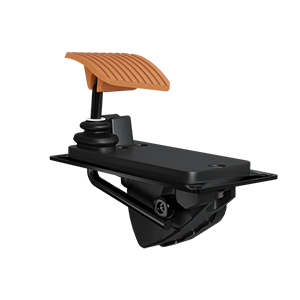
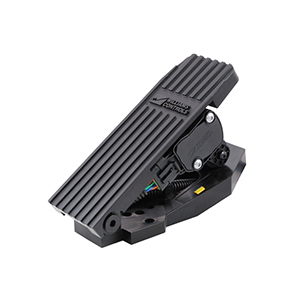
The Electronic Floor Pedal is available with a standard treadle angle of 35 or 45 degrees. The throttle Control is made out of high strength engineered plastics. The base plate has five mounting holes for various mounting options.
Williams Controls WM-558 Electronic Floor Pedal – Heavy-Duty Hall-Effect Accelerator Control
The Williams Controls WM-558 Electronic Floor Pedal is a rugged electronic throttle control engineered for commercial vehicle applications where accurate accelerator input, long operating life and dependable performance are essential. Combining non-contact Hall-effect sensing technology with a robust floor-mounted pedal assembly, the WM-558 provides equipment manufacturers with a reliable electronic interface between the vehicle operator and the engine or electronic control system. Its durable construction, extensive environmental protection and configurable electrical outputs make it particularly suitable for demanding on-highway, off-highway and specialised mobile equipment.
Modern commercial vehicles increasingly rely on electronic throttle control rather than traditional mechanical accelerator linkages. In these systems, the position of the accelerator pedal must be accurately converted into an electrical signal that can be interpreted by the vehicle’s Electronic Control Unit (ECU). The Williams Controls WM-558 performs this critical function using proven non-contact sensing technology designed to maintain consistent performance throughout millions of operating cycles.
The WM-558 has been developed for applications where conventional light-duty accelerator controls may not provide the durability, environmental resistance or configuration flexibility required by commercial vehicle manufacturers. Its engineered plastic treadle, strong mounting arrangement and protected electronics create a pedal assembly capable of operating in harsh environments while providing predictable pedal feel and accurate electronic output.
Electronic Floor Pedal Designed for Commercial Vehicles
The Williams Controls WM-558 is specifically designed for commercial vehicle applications. This makes it suitable for manufacturers and system integrators requiring an electronic accelerator pedal that can withstand frequent operation, substantial mechanical loading and the environmental conditions associated with professional mobile equipment.
Commercial vehicle controls face significantly different demands from conventional passenger vehicle components. Pedals may be operated continuously throughout long working shifts and can be exposed to dirt, moisture, vibration, temperature extremes and repeated high-force inputs. For this reason, accelerator pedal reliability is an important consideration when designing vehicles expected to remain productive over extended service periods.
The WM-558 addresses these requirements through a combination of mechanical strength and electronic durability. Its electronic sensing system is protected from the external operating environment, while the pedal structure is designed to accommodate the repeated loading associated with commercial vehicle use. This makes the WM-558 a practical choice for original equipment manufacturers seeking a durable electronic throttle interface for demanding vehicle platforms.
Non-Contact Hall-Effect Sensing Technology
At the heart of the WM-558 Electronic Floor Pedal is a Hall-effect non-contact sensor. This technology allows pedal position to be measured electronically without relying on a conventional resistive element with sliding electrical contacts.
As the operator depresses the pedal, the movement of the treadle changes the relationship between the magnetic components and the Hall-effect sensing electronics. The resulting change is converted into an electrical output representing pedal position. The vehicle’s electronic controller can then use this information to determine the required throttle or engine response.
The absence of contacting electrical sensing surfaces provides an important durability advantage. Traditional potentiometer-based position sensing technologies rely on mechanical contact between a wiper and resistive track. Repeated movement can gradually wear these surfaces and potentially affect signal quality. Hall-effect sensing removes this particular wear mechanism, supporting greater operational life and consistent output characteristics.
This is particularly valuable in accelerator applications because the pedal may be cycled many thousands of times during normal vehicle operation. The non-contact technology used by the WM-558 helps maintain dependable pedal position information throughout extended service while reducing the potential for sensor deterioration caused by repeated electrical contact wear.
Three Million Full-Travel Cycle Product Life
Durability is one of the most significant characteristics of the Williams Controls WM-558. The pedal is rated for a product life of 3,000,000 full-travel cycles, demonstrating its suitability for commercial equipment where accelerator controls may experience intensive daily use.
A long mechanical and electronic service life can provide important benefits for vehicle manufacturers, fleet operators and equipment owners. Accelerator pedal replacement can involve more than the cost of the component itself. Maintenance labour, vehicle downtime, fault diagnosis and lost productivity can all contribute to the total cost of a premature control failure.
By engineering the WM-558 around long-term commercial vehicle operation, Williams Controls provides OEMs with a throttle control suited to applications where reliability and machine availability are important design considerations. The combination of non-contact sensing and robust mechanical construction helps the pedal retain dependable operation across an extended service period.
35-Degree and 45-Degree Treadle Options
Vehicle cab layouts vary considerably between manufacturers and applications. Seating position, floor angle, available installation space and desired operator ergonomics can all influence the appropriate accelerator pedal geometry. To provide greater flexibility during vehicle design, the WM-558 Electronic Floor Pedal is available with standard treadle angles of 35 degrees or 45 degrees.
This choice gives OEM engineers greater flexibility when positioning the accelerator pedal relative to the driver’s seat and surrounding controls. Selecting an appropriate pedal angle can assist in creating a natural operating position, reducing unnecessary ankle movement and supporting comfortable vehicle operation during long working periods.
The availability of alternative treadle geometries is also beneficial when the same pedal technology is being considered across different vehicle platforms. Rather than requiring an entirely different accelerator control for each cab arrangement, manufacturers can select the WM-558 configuration that best suits the physical and ergonomic requirements of the application.
Configurable Electronic Output Signals
One of the important advantages of the WM-558 is its electrical configuration flexibility. The Hall-effect sensor can be programmed for analogue output and integrated switch functionality, while alternative contact or Pulse Width Modulation (PWM) sensor configurations can also be accommodated for specific applications.
Standard electrical output options include Dual Accelerator Position Sensor (Dual APS), APS/IVS, APS/IVS/IVS and Dual PWM configurations. This range allows the pedal to be matched to different electronic control architectures and ECU requirements.
Dual-channel configurations are particularly valuable in modern electronic throttle systems because they allow the vehicle controller to receive more than one pedal position signal. Depending on the system design, the ECU can compare these signals as part of its diagnostic and plausibility monitoring strategy. This provides OEM engineers with the flexibility required when integrating the accelerator pedal into sophisticated electronically managed powertrain systems.
Integrated switch configurations can provide additional state information alongside the proportional accelerator position signal. The exact configuration can therefore be selected according to the requirements of the engine controller, vehicle management system and overall electronic architecture.
IP68 and IP69K Sealed Electronics
Environmental protection is critical for an electronic floor-mounted control. Accelerator pedals can be exposed to moisture, dirt, dust and cleaning processes throughout the working life of a commercial vehicle. The WM-558 addresses these demanding conditions with electronics sealed to IP68 and IP69K in accordance with IEC 60529.
IP68 protection provides a high level of resistance to dust and water ingress, while IP69K protection is particularly relevant to equipment exposed to high-pressure, high-temperature washdown conditions. These characteristics make the electronic sensing system well suited to commercial and specialised vehicle environments where routine cleaning or severe contamination may occur.
Effective sealing helps protect the internal electronic components that generate the accelerator position signal. By isolating sensitive electronics from external contamination, the WM-558 can maintain dependable operation in environments that would present significant challenges for less protected electronic controls.
High Resistance to Electromagnetic Interference
Commercial vehicles contain an increasing number of electronic systems, including engine controllers, transmission electronics, hydraulic controllers, communication networks, electric motors, charging systems and auxiliary equipment. All of these components contribute to a complex electromagnetic operating environment.
The WM-558 electronics are designed to provide high resistance to electromagnetic interference and are compliant with SAE J1113 requirements. This is an important characteristic for an electronic accelerator pedal because the output signal must remain dependable while operating alongside numerous other electrical and electronic systems.
Electromagnetic compatibility helps OEM engineers integrate the pedal into modern vehicle architectures while maintaining reliable communication between the accelerator position sensor and the associated electronic controller. For vehicles incorporating sophisticated engine management and multiplexed electronic systems, this resistance to electromagnetic interference contributes to overall system robustness.
Engineered for Consistent Pedal Feel
Electronic performance is only one aspect of an accelerator pedal. The mechanical response experienced by the operator is equally important. The WM-558 is designed to provide a progressive pedal force as the treadle moves through its operating range.
Williams Controls specifies an operating force of approximately 17 N at idle and 45 N at full travel, measured 150 mm from the pivot point. This progressive resistance provides the operator with physical feedback as the accelerator is depressed, supporting predictable throttle control and helping the driver accurately modulate vehicle response.
A consistent pedal force characteristic can be particularly important in vehicles that are operated for extended periods or require frequent low-speed manoeuvring. Predictable accelerator feel helps the operator make controlled adjustments without relying solely on engine sound or vehicle movement to determine throttle position.
High-Strength Construction for Demanding Applications
The WM-558 throttle control makes extensive use of high-strength engineered plastics, providing a combination of mechanical durability, environmental resistance and efficient weight. The foot treadle is manufactured from composite plastic, while the base plate is available in diecast aluminium or composite plastic depending on the required configuration.
The base incorporates five mounting holes, providing manufacturers with flexibility when installing the pedal within different vehicle floor structures and cab designs. This mounting versatility is valuable for OEM applications where available space, floor construction and surrounding components can vary substantially between equipment platforms.
Together, the durable materials, flexible mounting arrangement, non-contact Hall-effect sensing technology and protected electronics provide the WM-558 with the foundation required for reliable electronic throttle control in demanding commercial vehicle applications.
Heavy-Duty Mechanical Performance
The Williams Controls WM-558 Electronic Floor Pedal has been engineered to withstand the substantial mechanical forces encountered in commercial vehicle applications. Accelerator pedals are subjected to thousands of repeated operator inputs, occasional excessive loading and continuous vibration generated by engines, drivetrains and uneven operating surfaces. The WM-558 combines a high-strength pedal structure with carefully engineered internal components to provide reliable operation under these demanding conditions.
Mechanical strength is particularly important for vehicles used in industrial and commercial environments, where the accelerator pedal may experience significantly greater loads than would normally occur during controlled laboratory operation. Operators wearing heavy work boots, repeated entry and exit from the cab and demanding operating conditions can all increase the mechanical stresses applied to a floor-mounted pedal assembly.
The WM-558 has therefore been designed around the requirements of commercial vehicle operation rather than light-duty applications. Its combination of engineered materials, secure mounting provisions and non-contact electronic sensing provides OEM designers with a durable accelerator interface suitable for long-term installation in demanding mobile equipment.
1500 N Static Load Capacity
One of the important mechanical specifications of the WM-558 is its ability to withstand a static load of 1500 N applied at 150 mm from the pedal pivot. This substantial load capacity demonstrates the mechanical strength of the pedal assembly and its suitability for demanding commercial vehicle installations.
The static load rating is particularly relevant because accelerator pedals can occasionally experience forces significantly greater than those generated during normal throttle operation. An operator may place substantial weight on the pedal when entering or leaving a vehicle, or the pedal may experience an abnormal load during harsh working conditions. Designing the assembly to withstand these higher forces provides additional mechanical robustness beyond the normal operating requirements of the accelerator.
This strength also supports long-term reliability. A mechanically stable pedal structure helps maintain the correct relationship between the treadle, pivot mechanism and electronic sensing components, allowing the accelerator position signal to remain consistent throughout the service life of the control.
Progressive Accelerator Pedal Force
In addition to mechanical strength, the WM-558 is engineered to provide a controlled increase in operating force as the pedal moves from idle towards full travel. At a measurement point 150 mm from the pivot, the specified operating force is approximately 17 N at idle and 45 N at full travel.
This progressive force characteristic provides valuable tactile feedback to the vehicle operator. Rather than moving through its range with little resistance, the pedal provides increasing physical feedback as greater accelerator demand is applied. This helps the operator judge throttle position naturally and supports precise modulation during low-speed manoeuvring, equipment positioning and other applications requiring controlled engine response.
Consistent pedal feel is particularly valuable during extended operating shifts. When accelerator resistance is predictable, operators can develop a natural understanding of the relationship between pedal movement and machine response. This contributes to smoother operation and can help reduce unnecessary rapid changes in throttle demand.
Resistance to Continuous Vehicle Vibration
Vibration is an unavoidable characteristic of commercial and off-highway vehicle operation. Diesel engines, hydraulic systems, drivetrains, tyres and operating terrain can transmit substantial vibration through the vehicle structure and into the operator cab. Electronic components installed within these environments must therefore be designed to continue functioning reliably despite prolonged mechanical excitation.
The WM-558 is specified for random broadband vibration testing up to 4 g across three axes, with three hours of testing applied to each axis. This multi-axis testing reflects the fact that a pedal installed within a vehicle can experience vibration from multiple directions rather than from a single predictable source.
Resistance to vibration is particularly important for an electronic accelerator pedal because the position sensor must continue to produce a dependable signal while the surrounding vehicle is subjected to continuous movement. Robust mechanical support and non-contact sensing help the WM-558 maintain consistent operation in these environments while reducing the potential for vibration-related wear within the sensing system.
Wide Operating Temperature Range
Commercial vehicles may be required to operate in dramatically different climatic conditions throughout their service life. Equipment can be exposed to freezing temperatures during winter operation, while enclosed cabins, engine compartments and outdoor industrial environments can produce elevated temperatures during summer or high-load working conditions.
The Williams Controls WM-558 is specified for operation across a temperature range of -40°C to +85°C. This broad operating envelope makes the pedal suitable for vehicles and mobile equipment intended for use across a wide variety of geographic and environmental conditions.
For OEM manufacturers supplying equipment internationally, this temperature capability can be particularly valuable. A pedal platform capable of operating across both extremely cold and hot conditions allows the same fundamental control solution to be considered for vehicle platforms destined for different markets.
Temperature capability is also important for the electronic sensing system. Accelerator position information must remain dependable as environmental conditions change, allowing the vehicle controller to interpret operator demand consistently throughout normal operation.
Storage Temperature Performance
The WM-558 is specified for storage temperatures ranging from -40°C to +105°C. Storage temperature capability is distinct from the normal operating range and is relevant during vehicle transportation, warehousing, manufacturing and periods when equipment is parked or otherwise inactive.
Vehicles can experience elevated internal temperatures when parked in direct sunlight, while components transported or stored in cold climates may be subjected to temperatures well below freezing. The WM-558’s specified storage range provides equipment manufacturers with a robust component suitable for the logistical and environmental conditions associated with global commercial vehicle production and operation.
Humidity Resistance for Challenging Environments
High humidity can present a significant challenge for electrical and electronic components. Prolonged exposure to moisture can contribute to corrosion, electrical leakage and deterioration of materials if components are not appropriately designed and protected.
The WM-558 has been subjected to humidity testing at 95% relative humidity for 120 hours across temperatures from 27°C to 75°C. Combined with the IP68 and IP69K sealing of its electronics, this demonstrates the emphasis placed on environmental durability within the pedal design.
This level of protection is especially relevant for commercial vehicles operating in tropical climates, coastal environments, agricultural applications and other locations where high humidity and moisture exposure are common. Effective protection of the internal electronics helps preserve dependable accelerator position sensing even when the surrounding vehicle environment is challenging.
Sand and Dust Resistance Tested to SAE J1455
Dust is another significant environmental consideration for commercial and off-highway equipment. Agricultural fields, construction sites, mines, quarries and unsealed roads can generate large quantities of fine airborne particles capable of entering poorly protected mechanical and electronic assemblies.
The Williams Controls WM-558 has been tested for sand and dust exposure in accordance with SAE J1455. This is particularly relevant for vehicle manufacturers designing equipment for severe mobile environments where accelerator controls may be exposed to contamination throughout every operating shift.
When combined with the sealed Hall-effect electronics, resistance to sand and dust helps reduce the risk of environmental contamination affecting the electrical sensing system. The non-contact nature of the sensor further supports reliability because pedal position is measured magnetically rather than through exposed sliding electrical contacts.
Dual APS Output for Electronic Throttle Systems
The WM-558 can be configured with Dual Accelerator Position Sensor (Dual APS) outputs. In an electronic throttle application, the accelerator position sensor communicates the driver’s throttle demand to the associated electronic control system. A dual-channel configuration provides two accelerator position signals that can be incorporated into the vehicle manufacturer’s control and diagnostic strategy.
This configuration is valuable in sophisticated electronic throttle architectures where signal plausibility and system diagnostics form part of the overall vehicle control design. The electronic controller can be engineered to evaluate the available accelerator position information according to the requirements of the engine, vehicle and application.
The WM-558’s availability with Dual APS therefore provides OEM engineers with an accelerator pedal platform suitable for integration into modern electronically controlled commercial vehicles while retaining the durability advantages of Hall-effect non-contact sensing.
APS and Idle Validation Switch Configurations
In addition to Dual APS, the WM-558 is available with APS/IVS and APS/IVS/IVS output arrangements. APS refers to the Accelerator Position Sensor, while IVS refers to an Idle Validation Switch. These configurations allow the accelerator pedal to provide proportional position information together with discrete switching information required by compatible electronic control systems.
The ability to combine accelerator position sensing and switch functionality within the pedal assembly gives vehicle manufacturers greater flexibility when developing throttle control architectures. Rather than requiring separate external devices to provide additional pedal-state information, the required functionality can be incorporated into an appropriately configured WM-558 assembly.
Because individual engine controllers and vehicle platforms can have different electrical requirements, the availability of multiple signal configurations makes the WM-558 particularly useful for OEM applications. Engineers can select a configuration suited to the intended control architecture while retaining a common pedal platform and mechanical installation concept.
Dual PWM Output Capability
The WM-558 is also available with Dual Pulse Width Modulation (PWM) output. PWM provides position information through the duty cycle of an electrical signal and can be advantageous for control systems specifically designed to interpret this form of electronic input.
The availability of Dual PWM alongside Dual APS and APS/IVS configurations demonstrates the adaptability of the WM-558 platform. Commercial vehicle manufacturers are not restricted to a single electrical architecture and can select an output arrangement appropriate for the vehicle controller, engine management system and application requirements.
This electrical flexibility can also support platform standardisation. Manufacturers developing multiple vehicle models may be able to retain the same fundamental pedal design while specifying different electronic configurations for individual powertrains or control systems.
Five-Hole Base Plate for Flexible Installation
Mechanical integration is another important consideration when selecting an accelerator pedal for an OEM vehicle platform. The WM-558 base plate incorporates five mounting holes, providing multiple mounting options for different floor structures and cab layouts.
This flexibility allows vehicle designers to consider the pedal alongside other important ergonomic factors including seat position, steering column placement, brake pedal location and available footwell space. Combined with the choice of 35-degree or 45-degree treadle angles, the mounting arrangement provides useful flexibility when optimising the driver’s accelerator position.
The base plate itself is available in diecast aluminium or composite plastic, while the foot treadle is manufactured from composite plastic. These engineered materials provide a balance between mechanical strength, environmental resistance and practical integration into commercial vehicle designs.
Engineered for Long-Term Electronic Throttle Control
The technical characteristics of the Williams Controls WM-558 demonstrate an accelerator pedal developed around the demanding requirements of commercial vehicle operation. Its 1500 N static load capability, 4 g multi-axis vibration testing, extensive temperature range, humidity resistance and SAE J1455 sand and dust testing provide a strong mechanical and environmental foundation for long-term vehicle use.
At the same time, the non-contact Hall-effect sensing system and choice of Dual APS, APS/IVS, APS/IVS/IVS and Dual PWM outputs provide the electrical flexibility required for modern electronic throttle control systems. Combined with IP68 and IP69K sealed electronics and a rated life of three million full-travel cycles, these characteristics make the WM-558 a highly capable electronic floor pedal for OEM commercial vehicle applications.
Heavy-Duty Mechanical Performance
The Williams Controls WM-558 Electronic Floor Pedal has been engineered to withstand the substantial mechanical forces encountered in commercial vehicle applications. Accelerator pedals are subjected to thousands of repeated operator inputs, occasional excessive loading and continuous vibration generated by engines, drivetrains and uneven operating surfaces. The WM-558 combines a high-strength pedal structure with carefully engineered internal components to provide reliable operation under these demanding conditions.
Mechanical strength is particularly important for vehicles used in industrial and commercial environments, where the accelerator pedal may experience significantly greater loads than would normally occur during controlled laboratory operation. Operators wearing heavy work boots, repeated entry and exit from the cab and demanding operating conditions can all increase the mechanical stresses applied to a floor-mounted pedal assembly.
The WM-558 has therefore been designed around the requirements of commercial vehicle operation rather than light-duty applications. Its combination of engineered materials, secure mounting provisions and non-contact electronic sensing provides OEM designers with a durable accelerator interface suitable for long-term installation in demanding mobile equipment.
1500 N Static Load Capacity
One of the important mechanical specifications of the WM-558 is its ability to withstand a static load of 1500 N applied at 150 mm from the pedal pivot. This substantial load capacity demonstrates the mechanical strength of the pedal assembly and its suitability for demanding commercial vehicle installations.
The static load rating is particularly relevant because accelerator pedals can occasionally experience forces significantly greater than those generated during normal throttle operation. An operator may place substantial weight on the pedal when entering or leaving a vehicle, or the pedal may experience an abnormal load during harsh working conditions. Designing the assembly to withstand these higher forces provides additional mechanical robustness beyond the normal operating requirements of the accelerator.
This strength also supports long-term reliability. A mechanically stable pedal structure helps maintain the correct relationship between the treadle, pivot mechanism and electronic sensing components, allowing the accelerator position signal to remain consistent throughout the service life of the control.
Progressive Accelerator Pedal Force
In addition to mechanical strength, the WM-558 is engineered to provide a controlled increase in operating force as the pedal moves from idle towards full travel. At a measurement point 150 mm from the pivot, the specified operating force is approximately 17 N at idle and 45 N at full travel.
This progressive force characteristic provides valuable tactile feedback to the vehicle operator. Rather than moving through its range with little resistance, the pedal provides increasing physical feedback as greater accelerator demand is applied. This helps the operator judge throttle position naturally and supports precise modulation during low-speed manoeuvring, equipment positioning and other applications requiring controlled engine response.
Consistent pedal feel is particularly valuable during extended operating shifts. When accelerator resistance is predictable, operators can develop a natural understanding of the relationship between pedal movement and machine response. This contributes to smoother operation and can help reduce unnecessary rapid changes in throttle demand.
Resistance to Continuous Vehicle Vibration
Vibration is an unavoidable characteristic of commercial and off-highway vehicle operation. Diesel engines, hydraulic systems, drivetrains, tyres and operating terrain can transmit substantial vibration through the vehicle structure and into the operator cab. Electronic components installed within these environments must therefore be designed to continue functioning reliably despite prolonged mechanical excitation.
The WM-558 is specified for random broadband vibration testing up to 4 g across three axes, with three hours of testing applied to each axis. This multi-axis testing reflects the fact that a pedal installed within a vehicle can experience vibration from multiple directions rather than from a single predictable source.
Resistance to vibration is particularly important for an electronic accelerator pedal because the position sensor must continue to produce a dependable signal while the surrounding vehicle is subjected to continuous movement. Robust mechanical support and non-contact sensing help the WM-558 maintain consistent operation in these environments while reducing the potential for vibration-related wear within the sensing system.
Wide Operating Temperature Range
Commercial vehicles may be required to operate in dramatically different climatic conditions throughout their service life. Equipment can be exposed to freezing temperatures during winter operation, while enclosed cabins, engine compartments and outdoor industrial environments can produce elevated temperatures during summer or high-load working conditions.
The Williams Controls WM-558 is specified for operation across a temperature range of -40°C to +85°C. This broad operating envelope makes the pedal suitable for vehicles and mobile equipment intended for use across a wide variety of geographic and environmental conditions.
For OEM manufacturers supplying equipment internationally, this temperature capability can be particularly valuable. A pedal platform capable of operating across both extremely cold and hot conditions allows the same fundamental control solution to be considered for vehicle platforms destined for different markets.
Temperature capability is also important for the electronic sensing system. Accelerator position information must remain dependable as environmental conditions change, allowing the vehicle controller to interpret operator demand consistently throughout normal operation.
Storage Temperature Performance
The WM-558 is specified for storage temperatures ranging from -40°C to +105°C. Storage temperature capability is distinct from the normal operating range and is relevant during vehicle transportation, warehousing, manufacturing and periods when equipment is parked or otherwise inactive.
Vehicles can experience elevated internal temperatures when parked in direct sunlight, while components transported or stored in cold climates may be subjected to temperatures well below freezing. The WM-558’s specified storage range provides equipment manufacturers with a robust component suitable for the logistical and environmental conditions associated with global commercial vehicle production and operation.
Humidity Resistance for Challenging Environments
High humidity can present a significant challenge for electrical and electronic components. Prolonged exposure to moisture can contribute to corrosion, electrical leakage and deterioration of materials if components are not appropriately designed and protected.
The WM-558 has been subjected to humidity testing at 95% relative humidity for 120 hours across temperatures from 27°C to 75°C. Combined with the IP68 and IP69K sealing of its electronics, this demonstrates the emphasis placed on environmental durability within the pedal design.
This level of protection is especially relevant for commercial vehicles operating in tropical climates, coastal environments, agricultural applications and other locations where high humidity and moisture exposure are common. Effective protection of the internal electronics helps preserve dependable accelerator position sensing even when the surrounding vehicle environment is challenging.
Sand and Dust Resistance Tested to SAE J1455
Dust is another significant environmental consideration for commercial and off-highway equipment. Agricultural fields, construction sites, mines, quarries and unsealed roads can generate large quantities of fine airborne particles capable of entering poorly protected mechanical and electronic assemblies.
The Williams Controls WM-558 has been tested for sand and dust exposure in accordance with SAE J1455. This is particularly relevant for vehicle manufacturers designing equipment for severe mobile environments where accelerator controls may be exposed to contamination throughout every operating shift.
When combined with the sealed Hall-effect electronics, resistance to sand and dust helps reduce the risk of environmental contamination affecting the electrical sensing system. The non-contact nature of the sensor further supports reliability because pedal position is measured magnetically rather than through exposed sliding electrical contacts.
Dual APS Output for Electronic Throttle Systems
The WM-558 can be configured with Dual Accelerator Position Sensor (Dual APS) outputs. In an electronic throttle application, the accelerator position sensor communicates the driver’s throttle demand to the associated electronic control system. A dual-channel configuration provides two accelerator position signals that can be incorporated into the vehicle manufacturer’s control and diagnostic strategy.
This configuration is valuable in sophisticated electronic throttle architectures where signal plausibility and system diagnostics form part of the overall vehicle control design. The electronic controller can be engineered to evaluate the available accelerator position information according to the requirements of the engine, vehicle and application.
The WM-558’s availability with Dual APS therefore provides OEM engineers with an accelerator pedal platform suitable for integration into modern electronically controlled commercial vehicles while retaining the durability advantages of Hall-effect non-contact sensing.
APS and Idle Validation Switch Configurations
In addition to Dual APS, the WM-558 is available with APS/IVS and APS/IVS/IVS output arrangements. APS refers to the Accelerator Position Sensor, while IVS refers to an Idle Validation Switch. These configurations allow the accelerator pedal to provide proportional position information together with discrete switching information required by compatible electronic control systems.
The ability to combine accelerator position sensing and switch functionality within the pedal assembly gives vehicle manufacturers greater flexibility when developing throttle control architectures. Rather than requiring separate external devices to provide additional pedal-state information, the required functionality can be incorporated into an appropriately configured WM-558 assembly.
Because individual engine controllers and vehicle platforms can have different electrical requirements, the availability of multiple signal configurations makes the WM-558 particularly useful for OEM applications. Engineers can select a configuration suited to the intended control architecture while retaining a common pedal platform and mechanical installation concept.
Dual PWM Output Capability
The WM-558 is also available with Dual Pulse Width Modulation (PWM) output. PWM provides position information through the duty cycle of an electrical signal and can be advantageous for control systems specifically designed to interpret this form of electronic input.
The availability of Dual PWM alongside Dual APS and APS/IVS configurations demonstrates the adaptability of the WM-558 platform. Commercial vehicle manufacturers are not restricted to a single electrical architecture and can select an output arrangement appropriate for the vehicle controller, engine management system and application requirements.
This electrical flexibility can also support platform standardisation. Manufacturers developing multiple vehicle models may be able to retain the same fundamental pedal design while specifying different electronic configurations for individual powertrains or control systems.
Five-Hole Base Plate for Flexible Installation
Mechanical integration is another important consideration when selecting an accelerator pedal for an OEM vehicle platform. The WM-558 base plate incorporates five mounting holes, providing multiple mounting options for different floor structures and cab layouts.
This flexibility allows vehicle designers to consider the pedal alongside other important ergonomic factors including seat position, steering column placement, brake pedal location and available footwell space. Combined with the choice of 35-degree or 45-degree treadle angles, the mounting arrangement provides useful flexibility when optimising the driver’s accelerator position.
The base plate itself is available in diecast aluminium or composite plastic, while the foot treadle is manufactured from composite plastic. These engineered materials provide a balance between mechanical strength, environmental resistance and practical integration into commercial vehicle designs.
Engineered for Long-Term Electronic Throttle Control
The technical characteristics of the Williams Controls WM-558 demonstrate an accelerator pedal developed around the demanding requirements of commercial vehicle operation. Its 1500 N static load capability, 4 g multi-axis vibration testing, extensive temperature range, humidity resistance and SAE J1455 sand and dust testing provide a strong mechanical and environmental foundation for long-term vehicle use.
At the same time, the non-contact Hall-effect sensing system and choice of Dual APS, APS/IVS, APS/IVS/IVS and Dual PWM outputs provide the electrical flexibility required for modern electronic throttle control systems. Combined with IP68 and IP69K sealed electronics and a rated life of three million full-travel cycles, these characteristics make the WM-558 a highly capable electronic floor pedal for OEM commercial vehicle applications.