
Description
Williams Controls WM-900 Non-Contact Dual Hall-Effect Rotary Position Sensor for Heavy-Duty Mobile Equipment and Industrial Control Systems
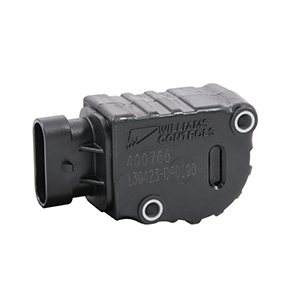
The Williams Controls WM-900 Non-Contact Dual Hall-Effect Rotary Position Sensor is a premium heavy-duty rotary position sensing device designed to provide highly accurate, reliable, and repeatable position feedback for modern electronically controlled vehicles and industrial equipment. Developed specifically for demanding mobile equipment applications, the WM-900 combines advanced Hall-effect sensing technology with a rugged mechanical design to deliver exceptional long-term reliability in harsh operating environments. Unlike conventional potentiometer-based position sensors that rely on mechanical contact between resistive tracks and wiper arms, the WM-900 operates using completely non-contact magnetic sensing technology. This eliminates internal mechanical wear, significantly extending service life while maintaining precise output accuracy over millions of operating cycles.
The increasing use of electronically controlled hydraulic systems, drive-by-wire technologies, advanced engine management systems, and intelligent vehicle control architectures has created a growing demand for highly reliable rotary position sensors capable of operating in severe environmental conditions. The Williams Controls WM-900 has been engineered to meet these requirements by delivering stable output signals, excellent linearity, dual redundant sensing capability, and outstanding resistance to vibration, moisture, temperature extremes, dust, chemicals, and mechanical shock. These characteristics make the WM-900 an ideal solution for OEM manufacturers seeking dependable position feedback in construction equipment, agricultural machinery, mining vehicles, municipal service vehicles, forestry equipment, material handling machines, and heavy-duty on-highway and off-highway vehicles.
Advanced Non-Contact Hall-Effect Sensing Technology
At the heart of the WM-900 is advanced Hall-effect sensing technology that measures rotary movement without physical contact between moving electrical components. A permanent magnet attached to the rotating shaft generates a controlled magnetic field that is continuously monitored by integrated Hall-effect sensing elements housed within the sensor body. As the shaft rotates, changes in magnetic field orientation are converted into highly accurate analogue electrical output signals that are transmitted directly to the machine’s electronic control unit (ECU).
Because there are no sliding contacts, resistive tracks, or mechanical wipers, the Hall-effect sensing principle virtually eliminates the wear mechanisms associated with traditional rotary potentiometers. The absence of friction greatly increases operational life while ensuring exceptional signal stability throughout the lifetime of the sensor. Output drift caused by component wear is significantly reduced, allowing machine manufacturers to achieve greater long-term control accuracy and improved overall system reliability.
The solid-state design also provides superior resistance to contamination from dust, mud, oil, hydraulic fluid, moisture, and other environmental contaminants that commonly cause premature failure in contact-based sensing technologies. This makes the WM-900 particularly suitable for equipment operating in harsh outdoor environments where dependable performance is essential.
Dual Hall-Effect Architecture for Functional Safety
One of the defining characteristics of the Williams Controls WM-900 is its dual Hall-effect architecture. The sensor incorporates two electrically isolated sensing circuits that simultaneously monitor shaft position while producing independent output signals. This redundant design provides an additional layer of operational security by allowing electronic controllers to continuously compare both signals and verify sensor integrity during normal machine operation.
Modern mobile equipment increasingly incorporates functional safety strategies that require continuous monitoring of operator inputs and actuator positions. The dual-output capability of the WM-900 enables sophisticated diagnostic routines that detect wiring faults, output inconsistencies, sensor degradation, or unexpected operating conditions before they affect machine performance.
Should one sensing channel experience an abnormal operating condition, the secondary channel provides an independent reference that allows the controller to identify the fault and initiate appropriate safety responses. This architecture contributes significantly to machine safety while improving overall equipment reliability and reducing the likelihood of uncontrolled machine operation.
Highly Accurate Rotary Position Measurement
The WM-900 has been engineered to provide precise angular position measurement across a wide range of rotary applications. Depending upon the specific model configuration, the sensor is capable of monitoring rotational movement through a broad operating range that can extend up to a full 360 degrees. This flexibility enables equipment manufacturers to utilise the sensor across numerous operator controls, actuator feedback systems, valve position monitoring applications, steering mechanisms, and electronically controlled hydraulic systems.
Excellent linearity characteristics ensure that the electrical output remains directly proportional to shaft position throughout the measurement range. This allows electronic control systems to calculate exact component position with a high degree of confidence, improving control precision and overall machine responsiveness.
The ability to maintain stable output characteristics over extended operating periods is particularly important in electronically controlled equipment where sensor accuracy directly influences productivity, fuel efficiency, machine safety, and operator comfort.
Flexible Electrical Output Configurations
Recognising that modern electronic control systems utilise a variety of input architectures, Williams Controls designed the WM-900 with multiple electrical output options to maximise OEM integration flexibility. Depending upon model selection, the sensor can be supplied with analogue voltage outputs, current outputs, pulse width modulation (PWM) outputs, or combinations of these signal formats.
Voltage outputs provide excellent compatibility with traditional electronic control units used throughout the automotive and off-highway industries, while current outputs offer improved noise immunity for installations involving longer cable runs or electrically noisy operating environments. PWM outputs provide an additional level of digital signal robustness for advanced electronic control architectures requiring high resistance to electrical interference.
This versatility enables OEM engineers to select the most appropriate output configuration for their specific control system without compromising sensor performance or reliability.
Excellent Electrical Performance
Stable electrical performance is essential for modern electronically controlled machinery, and the WM-900 has been developed with this requirement as a primary design objective. The sensor delivers smooth proportional output signals with excellent repeatability throughout the operating range. Advanced internal electronics minimise electrical noise while maintaining accurate signal integrity even when exposed to vibration, electrical transients, and rapidly changing environmental conditions.
The sensor operates from the low-voltage power supplies commonly used within heavy-duty vehicle electrical systems and industrial electronic controllers. Careful circuit design provides protection against supply voltage variation while maintaining highly accurate position measurement characteristics.
The electrically isolated redundant sensing circuits further improve system reliability by reducing the possibility of common-mode failures that could simultaneously affect both output channels. This redundancy is particularly valuable in safety-critical applications involving operator controls and machine motion.
Engineered for Harsh Environmental Conditions
Few operating environments are more demanding than those encountered by heavy-duty mobile equipment. Construction machinery, agricultural equipment, underground mining vehicles, forestry harvesters, and municipal service equipment routinely operate in rain, dust, mud, snow, vibration, and extreme temperature conditions.
The Williams Controls WM-900 has been specifically engineered to withstand these severe environments through a combination of rugged housing construction, advanced sealing technology, and environmentally resistant internal electronics. Depending upon the selected configuration, the sensor is available with IP67, IP68 and IP69K environmental protection ratings, providing exceptional resistance against water ingress, high-pressure wash-down procedures, dust contamination, and prolonged exposure to challenging outdoor environments.
This high level of environmental protection enables equipment manufacturers to confidently install the WM-900 in exposed locations where less robust sensors would experience premature failure. The resulting increase in reliability contributes directly to improved machine uptime and reduced maintenance costs throughout the operational life of the equipment.
Robust Mechanical Construction for Heavy-Duty Applications
The Williams Controls WM-900 has been engineered with a robust mechanical design capable of delivering reliable operation throughout the demanding service life expected of modern mobile equipment. Every component has been selected to withstand continuous exposure to vibration, mechanical shock, thermal cycling, and environmental contamination commonly experienced in construction, agricultural, mining, forestry, and material handling applications.
Unlike conventional contact-based rotary sensors that gradually degrade as internal mechanical components wear, the WM-900’s non-contact Hall-effect architecture virtually eliminates friction between sensing elements. The result is a significantly longer operational life while maintaining exceptional positional accuracy and signal repeatability. This durability makes the sensor particularly attractive for OEM manufacturers seeking components capable of matching the expected service life of the equipment itself.
The sensor housing has been designed to resist corrosion and environmental degradation while providing stable mechanical support for the internal electronics. Precision manufacturing techniques ensure accurate shaft alignment and consistent rotational performance throughout the operating range, even after years of continuous service in severe operating conditions.
Extended Service Life and Reduced Maintenance
Maintenance requirements remain one of the most significant operating costs associated with heavy-duty equipment fleets. The WM-900 addresses this challenge through a completely maintenance-free sensing design that eliminates the wear mechanisms associated with traditional potentiometer technology.
Williams Controls has designed the WM-900 to achieve an operational life of up to ten million rotational cycles, making it suitable for equipment expected to operate continuously over many years. This extended service life substantially reduces replacement intervals and contributes to lower lifetime ownership costs for fleet operators and equipment owners.
The elimination of internal mechanical wear not only increases durability but also improves long-term calibration stability. Equipment operators benefit from consistent machine performance throughout the service life of the sensor without requiring routine adjustment or recalibration.
Reduced maintenance requirements also contribute to improved equipment availability by minimising unscheduled downtime and reducing the frequency of service interventions. This advantage is particularly valuable in industries where equipment utilisation directly impacts operational productivity and profitability.
Outstanding Electromagnetic Compatibility Performance
Modern mobile equipment contains numerous electronic devices operating simultaneously within increasingly complex electrical environments. Engine controllers, hydraulic controllers, transmission modules, CAN bus communication systems, telematics equipment, GPS receivers, radios, and power electronics all generate electromagnetic interference that can potentially influence sensor performance.
The WM-900 has been developed to operate reliably within these electrically demanding environments by incorporating advanced electromagnetic compatibility (EMC) protection. The sensor has been designed to comply with recognised industry testing standards including SAE J1113, providing excellent resistance to conducted and radiated electromagnetic interference.
This high level of EMC performance ensures that sensor outputs remain stable even when installed alongside high-current electrical systems, hydraulic solenoids, electric motors, alternators, and radio communication equipment. Stable signal integrity enables electronic control units to make accurate control decisions regardless of external electrical noise.
For OEM manufacturers, this reduces development complexity while increasing confidence that electronic control systems will perform consistently throughout the operating life of the machine.
Flexible OEM Integration
The Williams Controls WM-900 has been engineered to simplify integration into both new equipment designs and existing electronic control systems. Its flexible electrical configurations, compact housing design, and multiple output options provide engineers with considerable freedom during machine development.
Whether integrated into accelerator pedal assemblies, hydraulic valve controls, steering mechanisms, transmission controls, or specialised operator interfaces, the sensor delivers dependable position feedback that supports accurate machine control and responsive operator interaction.
OEM engineers can select from multiple electrical output formats, connector arrangements, rotational ranges, and magnetic configurations to optimise system performance for individual machine requirements. This flexibility allows a common sensing platform to be utilised across multiple equipment models while simplifying inventory management and reducing development costs.
The WM-900 is equally suited to new product development and retrofit applications where upgrading from traditional potentiometer technology can significantly improve equipment reliability and operational performance.
Industry-Standard Electrical Connectivity
Reliable electrical connections are essential for ensuring dependable sensor performance in harsh operating environments. The WM-900 utilises proven automotive-grade connector technology, including Packard Metri-Pack 150 Series connectors that have become widely accepted throughout the heavy-duty vehicle and off-highway equipment industries.
These sealed connectors provide excellent resistance to vibration, moisture, corrosion, and contamination while maintaining secure electrical contact throughout years of operation. Their widespread industry adoption also simplifies wiring harness design, replacement part availability, and field servicing.
The use of standardised connectors enables equipment manufacturers to reduce assembly complexity while providing technicians with familiar connection systems that facilitate efficient maintenance and diagnostics.
Ideal for Construction Equipment
Construction machinery demands highly reliable sensing solutions capable of withstanding some of the harshest operating environments encountered by industrial equipment. Excavators, wheel loaders, bulldozers, graders, skid steer loaders, compact track loaders, cranes, and paving equipment routinely operate under conditions involving continuous vibration, dust, mud, hydraulic oil, water exposure, and significant mechanical shock.
The WM-900 has been specifically developed to meet these challenges by providing dependable rotary position feedback for hydraulic control levers, electronic throttle systems, steering mechanisms, transmission controls, attachment positioning systems, and numerous additional operator input devices.
Accurate position feedback enables electronic controllers to precisely regulate hydraulic flow, engine speed, steering response, and machine movement, improving productivity while enhancing operator confidence and overall machine safety.
Optimised for Agricultural Machinery
Agricultural equipment operates across an exceptionally broad range of environmental conditions, from dusty harvesting operations through to wet planting seasons and intensive wash-down procedures. The WM-900 provides the durability necessary to maintain reliable sensing performance throughout these demanding agricultural applications.
Modern tractors, harvesters, sprayers, balers, seeders, forage equipment, and self-propelled agricultural machinery increasingly rely upon electronically controlled hydraulic systems and intelligent vehicle management technologies. The WM-900 supplies accurate rotary position information required to support these sophisticated control systems.
Its non-contact sensing technology eliminates wear associated with repetitive operator inputs while maintaining consistent signal accuracy throughout years of continuous seasonal operation.
Mining Equipment Reliability
Mining environments present unique engineering challenges involving abrasive dust, vibration, extreme temperatures, moisture, and continuous equipment operation. Reliability is critical because equipment downtime directly impacts production efficiency and operating costs.
The WM-900 is particularly well suited to mining machinery including underground loaders, haul trucks, drilling equipment, shuttle cars, longwall equipment, continuous miners, and surface excavation machinery. Its rugged construction and advanced sealing technology provide dependable operation despite prolonged exposure to harsh mining conditions.
Long operational life combined with maintenance-free performance helps mining operators maximise equipment availability while reducing maintenance expenditure and replacement frequency.
Material Handling and Industrial Automation
The WM-900 also performs exceptionally well within industrial material handling systems where precise operator input directly influences equipment productivity. Forklifts, reach stackers, container handlers, automated guided vehicles, warehouse machinery, and specialised lifting equipment all benefit from accurate rotary position sensing.
Smooth proportional position feedback enables precise control of lifting mechanisms, steering systems, travel controls, and auxiliary hydraulic functions. The result is improved operator precision, reduced load handling errors, and increased workplace safety.
Industrial automation systems similarly benefit from the sensor’s high accuracy and exceptional repeatability, allowing electronic control systems to maintain consistent machine performance throughout prolonged production cycles.
Reliable Performance in Municipal and Specialty Vehicles
Municipal service vehicles, airport ground support equipment, utility service vehicles, road maintenance machinery, emergency response equipment, and specialised industrial vehicles all require dependable electronic position sensing capable of operating in highly variable environmental conditions.
The WM-900 provides manufacturers with a proven sensing platform suitable for these demanding applications. Whether installed within operator control panels, hydraulic actuators, auxiliary equipment controls, or specialised vehicle functions, the sensor delivers dependable position feedback that supports safe and efficient vehicle operation.
Its ability to resist environmental contamination while maintaining precise output characteristics makes it an excellent choice for equipment expected to remain in service for many years under intensive operating schedules.
Advantages Over Conventional Potentiometer Sensors
For many years, potentiometer-based rotary sensors have been widely used to provide position feedback in industrial machinery and mobile equipment. While these devices remain suitable for some applications, they rely on physical contact between a resistive track and a moving wiper arm. Over time, continual mechanical contact results in gradual wear, increased electrical resistance, signal instability, and eventual component failure.
The Williams Controls WM-900 eliminates these limitations through the use of advanced non-contact Hall-effect technology. Because the sensing elements never physically touch the rotating shaft or magnet, there is virtually no mechanical wear within the sensing mechanism itself. This significantly extends operational life while maintaining consistent output accuracy over millions of operating cycles.
The absence of internal friction also reduces hysteresis and improves signal repeatability, enabling electronic control systems to respond more accurately to operator inputs. For applications requiring precise machine control, this improved consistency contributes to smoother operation, greater productivity, and enhanced operator confidence.
In addition to improved durability, the WM-900 offers superior resistance to dust, moisture, vibration, hydraulic fluids, cleaning chemicals, and temperature extremes. These environmental advantages allow the sensor to outperform conventional contact sensors in many of today’s demanding heavy-duty applications.
Diagnostic Capability and System Reliability
As electronically controlled machines become increasingly sophisticated, continuous system diagnostics have become an important part of overall machine safety and reliability. The WM-900 supports these requirements through its dual independent sensing architecture, allowing electronic control units to compare two separate output signals during normal operation.
This redundancy enables the controller to identify abnormal operating conditions such as wiring faults, unexpected signal deviations, electrical failures, or sensor damage before they affect machine performance. By detecting faults at an early stage, equipment manufacturers can implement protective operating strategies that minimise the risk of uncontrolled machine movement while assisting technicians during maintenance and troubleshooting.
The combination of non-contact sensing, redundant outputs, and stable electrical performance makes the WM-900 an excellent choice for modern electronically controlled vehicles that demand high levels of reliability and operational safety.
Simple Installation and OEM Integration
The WM-900 has been designed to integrate easily into both new equipment designs and replacement applications. Its compact form factor, flexible mounting arrangements, and industry-standard electrical connections simplify installation while allowing engineers to incorporate the sensor into a wide variety of mechanical systems.
Depending on the selected configuration, the sensor can operate with either an integrated magnet arrangement or an external magnetic actuator. This flexibility enables OEM designers to optimise packaging requirements without sacrificing sensing accuracy or long-term reliability.
Correct installation involves ensuring accurate shaft alignment, secure mounting, and appropriate electrical connection in accordance with the equipment manufacturer’s design requirements. Once installed, the non-contact sensing principle requires no mechanical adjustment throughout the normal operating life of the sensor.
Virtually Maintenance-Free Operation
One of the greatest benefits offered by the Williams Controls WM-900 is its exceptionally low maintenance requirement. Since there are no internal contact surfaces to wear, routine servicing associated with conventional rotary potentiometers is effectively eliminated.
Operators can therefore expect consistent performance over many years of operation without the need for periodic calibration, adjustment, or replacement due to normal mechanical wear. This contributes directly to lower maintenance costs, reduced equipment downtime, and improved fleet availability.
For equipment owners operating large fleets of construction, agricultural, mining, forestry, or municipal vehicles, the resulting reduction in service interventions can produce significant long-term cost savings while improving overall operational efficiency.
Applications Across Multiple Industries
The versatility of the WM-900 allows it to be incorporated into an extensive range of industrial and mobile equipment applications where dependable rotary position feedback is essential. Typical installations include electronic accelerator pedals, hydraulic joystick controls, transmission selectors, steering systems, articulated vehicle controls, valve position monitoring, lift controls, boom positioning systems, operator armrests, suspended pedals, electronic throttle assemblies, industrial automation equipment, and numerous other proportional control applications.
Its rugged construction and reliable performance have made the WM-900 a preferred solution wherever accurate electronic position measurement is required under severe operating conditions. Equipment manufacturers benefit from a sensor platform that combines exceptional durability with flexible electrical integration and outstanding environmental resistance.
Why Choose the Williams Controls WM-900?
Selecting the appropriate rotary position sensor is critical to the long-term reliability and performance of electronically controlled equipment. The Williams Controls WM-900 has earned its reputation through decades of engineering development focused on delivering dependable operation in some of the world’s most demanding mobile equipment environments.
Its combination of advanced Hall-effect sensing technology, dual redundant output architecture, robust mechanical construction, excellent electromagnetic compatibility, flexible electrical configurations, and outstanding environmental protection provides OEM manufacturers with a sensing solution capable of supporting modern electronic control systems throughout extended service life.
Whether incorporated into newly designed machinery or used as part of an equipment upgrade programme, the WM-900 delivers the accuracy, durability, and reliability expected by manufacturers, fleet operators, service technicians, and equipment owners alike.
Conclusion
The Williams Controls WM-900 Non-Contact Dual Hall-Effect Rotary Position Sensor represents a significant advancement in rotary position sensing technology for heavy-duty mobile equipment and industrial control systems. By combining non-contact magnetic sensing with dual redundant Hall-effect circuitry, the sensor delivers highly accurate proportional position feedback while virtually eliminating the wear mechanisms associated with traditional potentiometer technology.
Designed specifically for demanding environments, the WM-900 provides dependable performance across construction, agriculture, mining, forestry, municipal services, material handling, and industrial automation applications. Its ability to withstand vibration, moisture, dust, temperature extremes, and high-pressure wash-down procedures makes it an ideal choice for equipment operating in harsh outdoor conditions.
With support for multiple electrical output configurations, excellent EMC performance, long operational life, and minimal maintenance requirements, the WM-900 enables equipment manufacturers to improve machine reliability while reducing total ownership costs. For organisations seeking a proven rotary position sensor capable of delivering precise, repeatable, and dependable performance over millions of operating cycles, the Williams Controls WM-900 continues to be a trusted solution that meets the rigorous demands of today’s electronically controlled mobile equipment and industrial machinery.