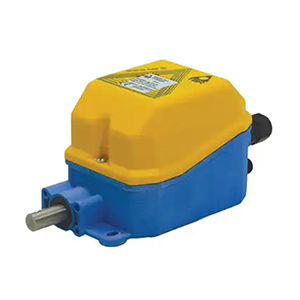

Description
TER Atlante EVO Electronic Rotary Limit Switch
The TER Atlante EVO Electronic Rotary Limit Switch is a compact, high-resolution electronic movement control device designed to monitor rotational position and provide programmable switching functions for industrial machinery. Combining a multi-turn absolute magnetic encoder with six configurable relay outputs, Atlante EVO provides a modern electronic alternative to traditional mechanically geared rotary limit switches while retaining the practical relay-based control functions required by industrial machinery.
At the heart of Atlante EVO is a high-resolution 28-bit multi-turn absolute magnetic encoder capable of continuously determining the angular and multi-turn position of the connected machine shaft. This electronic position information is used to control six relays that can emulate up to six conventional cams, allowing predetermined switching positions to be established through software rather than through the physical adjustment of mechanical cam discs.
The result is a highly configurable electronic rotary limit switch suitable for applications ranging from cranes, winches and hoists through to automation systems, industrial doors, lifting equipment, stage technology, machine tools, agricultural machinery, amusement rides and wind turbines.
For machine builders, system integrators and operators seeking greater configuration flexibility than a conventional mechanical rotary limit switch can provide, TER Atlante EVO combines absolute position measurement, programmable electronic switching and industrial relay outputs within a compact and robust assembly.
Electronic Rotary Limit Switch for Industrial Machinery
A traditional rotary limit switch normally uses a mechanical gear train to reduce input-shaft rotation before operating physically adjustable cams. Those cams then actuate electromechanical switches at predetermined positions.
Atlante EVO approaches the same fundamental machine-control requirement electronically.
Instead of relying on a conventional mechanical cam stack to establish the switching positions, the device measures shaft position using an absolute magnetic encoder and uses this position information to operate configurable electrical relays.
These relays emulate the functions normally associated with mechanical cams, providing machine-control outputs at programmed rotational positions.
Electronic Cam Emulation
Atlante EVO is equipped with six relays capable of emulating up to six cams.
Each electronic cam can be assigned programmed activation positions according to the movement requirements of the machinery. Current TER documentation specifies that each emulated cam can have up to five activation positions that are fully software programmable.
This gives machine designers considerable flexibility when establishing switching sequences because the operating points can be configured electronically rather than being limited to the physical geometry and adjustment range of a conventional cam mechanism.
Up to Six Programmable Electronic Cams
Six electronic cam channels allow Atlante EVO to provide multiple independent switching functions from one rotational position input.
For a simple machine, only a small number of outputs may be required. More sophisticated applications can use additional relays for operational limits, preliminary switching points, auxiliary functions, position indication or appropriately engineered safety-related functions.
The ability to configure up to six independent cam functions gives Atlante EVO significant flexibility across machinery with complex movement-control requirements.
Up to Five Activation Positions per Electronic Cam
An important advantage of the Atlante EVO architecture is that each emulated electronic cam can have up to five software-programmable activation positions.
This means an individual relay function is not necessarily restricted to one simple mechanical switching position.
Multiple activation regions or positions can be established through software, providing substantially greater control flexibility than would normally be available from a single physical mechanical cam.
This capability can be particularly useful in automated machinery where several defined regions of a rotational operating cycle must produce the same control output.
28-Bit Overall Position Resolution
Atlante EVO provides an overall encoder resolution of 28 bits.
This is achieved through the combination of 12-bit single-turn resolution and 16-bit multi-turn resolution.
The high-resolution measurement architecture allows the device to distinguish fine angular movement within each shaft revolution while simultaneously tracking the number of complete revolutions across a very large multi-turn operating range.
12-Bit Single-Turn Resolution
Within each individual shaft revolution, Atlante EVO provides 12-bit position resolution.
This corresponds to 4,096 measurement points per revolution.
Dividing one complete 360-degree revolution into 4,096 measurement positions provides fine angular discrimination and allows electronic switching positions to be established with substantially greater resolution than is normally practical with manually adjusted mechanical cams.
4,096 Measurement Points per Revolution
The 4,096-point single-turn measurement system provides Atlante EVO with a detailed electronic representation of shaft position.
Each complete revolution is divided into thousands of individual measurement increments, allowing the controller to determine the position of the shaft with a high level of resolution.
This is especially valuable where precise switching positions are required or where several electronic cam functions must be positioned close together within the same operating cycle.
Fine Angular Position Measurement
A 12-bit single-turn measurement provides a theoretical angular increment of approximately 0.088 degrees per measurement point.
This high measurement resolution gives machine designers considerably more flexibility when establishing switching positions than a conventional manually adjusted cam mechanism.
The practical accuracy of the complete machine will also depend on mechanical coupling, backlash, shaft alignment, machine dynamics and the specified accuracy of the Atlante EVO itself.
16-Bit Multi-Turn Resolution
In addition to its 12-bit single-turn measurement capability, Atlante EVO provides 16-bit multi-turn resolution.
TER specifies a multi-turn measurement range of up to 65,535 revolutions.
This allows the device to track machine position over a very large number of shaft rotations without requiring the extensive mechanical reduction gearing normally associated with conventional multi-turn rotary limit switches.
Up to 65,535 Revolutions
The ability to track up to 65,535 revolutions makes Atlante EVO suitable for machinery with substantial travel ranges.
Applications such as hoists, winches, lifting systems and other mechanisms can involve many shaft revolutions between their minimum and maximum positions.
By electronically counting and measuring these revolutions, Atlante EVO can establish switching positions throughout a large operating range while maintaining absolute multi-turn position information.
Multi-Turn Absolute Position Measurement
Atlante EVO is an absolute encoder-based device rather than a simple incremental rotation counter.
An absolute position measurement system associates the measured shaft position with a defined numerical value, allowing the control device to determine the position represented by the encoder rather than simply generating pulses as the shaft moves.
This is particularly valuable in industrial movement-control applications where switching functions depend on knowing where the machinery is located within its operating range.
Magnetic Encoder Technology
The position measurement system within Atlante EVO is based on magnetic encoder technology.
Magnetic sensing allows shaft position to be measured without using the mechanical cam stack found in a traditional rotary limit switch.
The use of a magnetic absolute encoder contributes to the compact design of Atlante EVO while providing the high single-turn and multi-turn resolution required for programmable electronic cam operation.
Eliminating Conventional Mechanical Cam Adjustment
One of the major practical differences between Atlante EVO and a conventional rotary limit switch is the method used to establish switching positions.
Traditional limit switches require technicians to open the enclosure and physically rotate or adjust individual cams until each switch operates at the desired machine position.
Atlante EVO replaces these physical cam adjustments with software-programmable electronic switching positions.
This can make configuration more flexible, particularly where several switching points must be established or changed during machine commissioning.
Software-Programmable Switching Positions
The electronic architecture allows switching positions to be configured through the Atlante EVO interface rather than mechanically altering individual cams.
Once the machine position has been related to the encoder measurement range, activation positions can be established for the required relay functions.
This allows machine-control settings to be configured with a level of numerical precision that is difficult to achieve using conventional mechanical cam adjustment alone.
Improved Repeatability
Electronic position measurement can provide excellent switching repeatability because the relay commands are derived from the measured encoder position rather than from physical interaction between an adjustable cam and a mechanical switch actuator.
TER identifies high-quality materials and components as contributing to precision and repeat accuracy even under demanding operating conditions.
Mechanical characteristics of the complete machine, including shaft coupling and gearbox backlash, should still be considered when assessing overall system repeatability.
Measurement Accuracy
TER specifies Atlante EVO measurement accuracy of ±0.5%.
Accuracy describes how closely the measured position corresponds with the actual shaft position within the specified operating conditions.
This characteristic should be considered together with the encoder resolution and the mechanical accuracy of the connected machine when determining the overall positioning performance of the application.
Linearity of ±0.25%
Atlante EVO provides specified linearity of ±0.25%.
Linearity describes the consistency of the relationship between the actual shaft movement and the electronic position measurement across the operating range.
Good linearity contributes to predictable electronic cam switching throughout the movement of the machine.
Six Configurable Relay Outputs
Atlante EVO converts its electronic position information into practical industrial control outputs through six configurable relays.
This relay-based architecture is particularly useful because it allows the electronic rotary limit switch to interface with conventional industrial control circuits without requiring the machine controller to interpret raw encoder position data for every limit function.
The relays can provide discrete switching outputs that can be incorporated into PLC inputs, contactor circuits and other suitable machine-control architectures.
Relay-Based Electronic Cam Functions
Each relay can be associated with an electronic cam function.
When the measured shaft position enters the programmed activation condition, the corresponding relay changes state according to its configuration.
This provides the functional equivalent of a mechanical cam operating a switch, but with the switching position determined electronically.
Normally Open or Normally Closed Relay Configuration
TER specifies the Atlante EVO relay outputs as configurable for normally closed or normally open operation.
This gives system designers flexibility when integrating the electronic limit switch with different machine-control architectures.
The selected contact logic should reflect the function of the circuit and, where relevant, the required fault-response behaviour.
Two 10 A Relays with Safety Function
Among the six relay outputs, TER identifies two 10 A relays with safety functionality.
These outputs provide additional capability for applications where selected electronic cam functions are incorporated into appropriately engineered safety-related machine controls.
The presence of safety-function relays does not by itself establish the safety performance of the complete machine. The complete safety architecture, control logic, diagnostics, installation and validation must be considered according to the applicable machinery requirements.
Relay Electrical Ratings
TER specifies six relays rated at 60/125 V with 3/10 A capabilities depending on the relay configuration, including two 10 A relays with safety function.
These ratings allow Atlante EVO to provide practical discrete control outputs for industrial machinery.
The electrical load connected to each relay must remain within the applicable specification for the selected configuration.
24 Vdc Power Supply
Atlante EVO operates from a nominal 24 Vdc power supply with a permitted tolerance of ±20%.
Twenty-four volt DC control power is widely used throughout industrial automation and machinery, making Atlante EVO straightforward to integrate into many existing electrical control systems.
The supply should provide stable power within the specified voltage range under all normal operating conditions.
Maximum Current Consumption of 240 mA
TER specifies a maximum current consumption of 240 mA.
This figure should be included when calculating the capacity of the machine’s 24 Vdc control power supply.
Appropriate allowance should also be made for other devices sharing the same power source and for normal engineering design margins.
Reverse Polarity Protection
Atlante EVO incorporates protection against reverse polarity.
This helps protect the electronic device if the DC supply polarity is accidentally connected incorrectly during installation or servicing.
Correct wiring should nevertheless always be verified before the system is energised.
Over-Voltage Protection
TER’s current product information identifies protection against over-voltage as part of the Atlante EVO electrical design.
This provides an additional level of protection for the electronic circuitry against unsuitable supply conditions.
The device should still be operated from a correctly specified and appropriately protected industrial 24 Vdc supply.
Short-Circuit Protection
Atlante EVO also incorporates short-circuit protection within its electronic architecture.
Protective features such as short-circuit and reverse-polarity protection contribute to a robust industrial control solution, particularly during installation, commissioning and fault conditions.
They do not replace correct external circuit protection or good electrical design practices.
RS-485 Industrial Communication Interface
Atlante EVO incorporates an RS-485 bus interface for industrial communication and configuration.
RS-485 is widely used in industrial environments because it provides robust differential serial communication suitable for connecting devices over practical machine distances.
This interface expands Atlante EVO beyond the capabilities of a purely relay-based rotary limit switch by allowing electronic communication with compatible systems.
Modbus RTU over RS-485
Current TER product documentation identifies Modbus RTU communication over the RS-485 bus.
Modbus RTU is a widely established industrial communication protocol and provides a practical method for exchanging information with compatible controllers and configuration systems.
This capability can support integration of Atlante EVO into modern automation architectures while the six relays continue to provide conventional discrete machine-control outputs.
PC Configuration
Atlante EVO can be configured using a PC-based configurator for Windows.
Software configuration provides a practical interface for establishing electronic cam positions and other device parameters.
This approach can simplify commissioning compared with repeatedly opening and mechanically adjusting a traditional rotary limit switch.
Electronic Configuration for Machine Commissioning
During commissioning, the connected machinery can be moved to the required positions and the corresponding electronic cam activation points configured within Atlante EVO.
This provides technicians with a numerical and software-based method of establishing the switching sequence.
Where changes are required, the programmed positions can be revised without mechanically repositioning physical cams.
CAN Bus Development
TER currently identifies CAN bus functionality for Atlante EVO as coming soon.
CAN bus is widely used in mobile machinery, lifting equipment and industrial control systems, so future availability can provide another useful integration option for suitable applications.
Because TER presently identifies this functionality as coming soon, CAN bus availability should be confirmed for the exact product version before it is specified for a project.
Bluetooth and Mobile Configuration Development
TER also identifies Bluetooth configuration through a mobile application as coming soon.
This planned functionality is intended to provide another convenient method for configuring the electronic limit switch.
Until the feature is confirmed as released for the required product version, the current PC and RS-485 configuration methods should be used as the basis for engineering decisions.
Maximum Rotation Speed of 800 rpm
Atlante EVO supports a maximum shaft rotation speed of 800 rpm.
This allows the electronic rotary limit switch to be directly connected to a broad range of industrial machine shafts and drive mechanisms.
The maximum rotational speed of the application should be determined under all operating conditions and confirmed to remain within this specification.
No Conventional Mechanical Reduction Ratio Required
Traditional multi-turn rotary limit switches often require a carefully selected mechanical reduction ratio so that the internal cams move through the correct angular range over the complete machine travel.
Atlante EVO uses multi-turn electronic position measurement instead.
Its ability to track up to 65,535 revolutions provides a very large electronic measuring range without requiring the extensive selection of mechanical gear ratios associated with conventional rotary limit switches.
Simplifying Product Selection
The electronic multi-turn architecture can simplify the selection process for applications where the number of shaft revolutions varies significantly between machine designs.
Instead of selecting a specific internal mechanical reduction ratio, the engineer can concentrate on the actual rotational operating range, required electronic cam positions, maximum shaft speed and relay functions.
This can make Atlante EVO particularly attractive for OEMs producing several machine variants with different travel ranges.
IP42 Without Cover
TER specifies Atlante EVO as IP42 when used without the protective cover.
This configuration provides a basic level of protection but is not intended to provide the same environmental resistance as the fully covered version.
The required protection level should therefore be considered carefully when determining the installation arrangement.
IP65 Protection
With the appropriate cover installed, Atlante EVO provides IP65 protection.
This offers complete protection against dust ingress and protection against water jets under the conditions defined by the IP classification.
IP65 construction makes the covered Atlante EVO suitable for many demanding industrial environments where dust and moisture may be present.
Operating Temperature from -25°C to +80°C
Atlante EVO is designed to operate across a broad temperature range from -25°C to +80°C.
This wide temperature capability supports use in machinery exposed to changing environmental and operating conditions.
The temperature of the actual installation should include consideration of ambient conditions, nearby heat sources and enclosure effects.
Technopolymer Nylon Housing
The Atlante EVO enclosure is manufactured from technopolymer nylon.
This provides a durable and relatively lightweight housing for the internal electronic and relay components.
TER selects high-quality materials and components to provide mechanical durability, precision and repeatability under demanding industrial operating conditions.
AISI 303 Non-Magnetic Stainless-Steel Shaft
The input shaft is manufactured from non-magnetic AISI 303 stainless steel.
Using a non-magnetic stainless-steel shaft is particularly relevant to the magnetic encoder architecture because it supports the mechanical interface without unnecessarily interfering with the magnetic position-measurement principle.
The stainless-steel construction also provides the mechanical durability expected from an industrial rotary control device.
Compact Overall Dimensions
Atlante EVO combines its multi-turn encoder, relay outputs and electronic control architecture within a compact enclosure.
TER specifies overall dimensions of approximately 91 x 132.5 x 90 mm.
The compact design can simplify installation in machinery where available space around shafts, gearboxes and drive mechanisms is limited.
Two M20 Cable Glands
Atlante EVO incorporates two M20 cable glands for electrical wiring.
These cable entries provide a practical method for routing power, relay and communication wiring into the device while maintaining the appropriate enclosure protection when correctly installed.
Cable outside diameter and gland compatibility should be checked during installation.
8-Pin M12 Male Connector
In addition to the cable glands, TER identifies an 8-pin M12 male connector as part of the Atlante EVO connection arrangement.
M12 connectors are widely used in industrial automation because they provide compact, robust and serviceable electrical connections.
The exact pin allocation should be followed according to the current TER wiring and installation documentation.
Mechanical Accessories
TER offers Atlante EVO with a range of mechanical accessories including flanges, pinion gears and couplings.
These accessories allow the electronic rotary limit switch to be connected to different machine shafts and drive arrangements.
The mechanical interface should be selected so that the encoder shaft accurately represents the movement being monitored.
Universal Adapter Plates
Universal adapter plates are available to assist with replacement of existing systems.
This is especially useful in retrofit applications where the mounting pattern of the existing rotary limit switch differs from the Atlante EVO enclosure.
Using a suitable adapter can reduce the mechanical modifications required during machine modernisation.
Compatibility with TER FOX Rotary Limit Switch Systems
A particularly important feature of Atlante EVO is its compatibility with systems designed to mount the TER FOX rotary limit switch.
This allows Atlante EVO to be integrated into machinery where a FOX mechanical rotary limit switch has previously been used, creating a practical pathway from mechanical cam-based switching to electronic multi-turn position control.
This compatibility can be valuable for machine modernisation, OEM design evolution and retrofit projects where the benefits of programmable electronic cams are required without completely redesigning the mechanical mounting arrangement.
Electronic Upgrade from Mechanical Rotary Limit Switching
For machinery originally designed around a mechanical FOX rotary limit switch, Atlante EVO can provide an opportunity to introduce electronic position measurement and programmable relay switching while retaining a familiar mechanical installation concept.
The upgrade can remove the need to select and adjust conventional internal gear ratios and mechanical cams, replacing these functions with high-resolution multi-turn measurement and software-defined switching positions.
This can significantly increase configuration flexibility while retaining discrete relay outputs suitable for conventional industrial control systems.
Winches and Hoists
Winches and hoists are important applications for Atlante EVO because drum or gearbox rotation can be directly related to movement of the lifting mechanism.
The 16-bit multi-turn measurement range allows the device to track large numbers of shaft revolutions, while programmable electronic cams can establish upper limits, lower limits, slowdown positions and other control points.
Multiple relay outputs allow several functions to be derived from the same absolute position measurement.
Overhead Travelling and Gantry Cranes
TER identifies overhead travelling cranes and gantry cranes among the applications for Atlante EVO.
The electronic rotary limit switch can be integrated into suitable hoisting and travel mechanisms where shaft rotation corresponds with machine movement.
High-resolution position measurement and configurable relay outputs make the device particularly useful where several control positions must be established across a large operating range.
Tower Cranes
Tower crane systems can involve complex lifting and movement functions requiring dependable position-related switching.
Atlante EVO provides a compact electronic solution capable of tracking multi-turn movement and generating several independent relay outputs.
Software-programmable electronic cams also provide flexibility when commissioning or adapting the control system to different machine configurations.
Harbour and Hydraulic Cranes
Harbour cranes and hydraulic cranes are also identified by TER as suitable application areas.
These machines can require robust position-control components capable of operating under demanding industrial conditions.
The IP65 covered construction, wide -25°C to +80°C temperature range and industrial mechanical design help support these applications.
Stage Technology
Stage machinery frequently requires repeatable control of hoists, winches and moving structures.
Atlante EVO’s programmable electronic cam architecture allows several position-dependent control functions to be established within a single device.
TER also identifies compliance with BGV C1 accident-prevention requirements for Germany for the applicable product configuration, making the product particularly relevant to specialised stage-technology applications where those requirements apply.
Industrial Doors, Gates and Barriers
Industrial high-speed doors, gates and barriers can use shaft rotation to represent the position of the moving structure.
Atlante EVO can electronically track this rotation and operate relays at programmed open, closed or intermediate positions.
The ability to configure multiple activation points can provide additional flexibility for slowdown zones, interlocks or auxiliary machine functions.
Automation, Assembly Lines and Machine Tools
Atlante EVO is equally applicable to general industrial automation.
Assembly lines and machine tools frequently require switching events at defined points within a repeated mechanical cycle.
The combination of absolute multi-turn measurement, programmable electronic cams, relay outputs and RS-485 communication provides a flexible position-control platform for these applications.
Industrial Handling and Intralogistics
TER specifically positions Atlante EVO for industrial handling machinery and intralogistics as well as conventional automation.
Material-handling equipment can involve repeated multi-turn movement where several position-dependent actions must occur throughout the operating cycle.
Electronic cam programming allows these actions to be established from one absolute position reference.
Additional Mobile and Industrial Applications
TER identifies a broad range of additional applications for Atlante EVO including strapping machines, automatic car washes, aerial platforms and lifts, lifting platforms, earthmoving machinery, agricultural machinery, truck equipment, amusement rides and wind turbines.
This diversity reflects the flexibility of the electronic multi-turn architecture. Wherever machine movement can be represented reliably by rotation of the Atlante EVO input shaft, the encoder position can potentially be used to establish programmable relay switching functions.
A Modern Electronic Rotary Limit Switch Platform
The TER Atlante EVO combines the practical control concept of a rotary limit switch with the precision and flexibility of a high-resolution electronic absolute encoder.
Its 28-bit overall resolution combines 4,096 measurement points per revolution with a multi-turn range of up to 65,535 revolutions, allowing detailed position measurement across extensive machine travel.
Six configurable relays emulate up to six electronic cams, with each cam capable of supporting multiple software-programmable activation positions. This provides substantially greater configuration flexibility than conventional fixed mechanical cam arrangements.
With 24 Vdc operation, RS-485 and Modbus RTU communication, industrial relay outputs, IP65 protection, an operating range from -25°C to +80°C and compatibility with TER FOX mounting systems, Atlante EVO provides a powerful electronic movement-control solution for modern industrial machinery.
Advanced Electronic Architecture of the TER Atlante EVO
The TER Atlante EVO combines absolute multi-turn position measurement, programmable electronic cam functions and industrial relay outputs within one compact device. This architecture allows the product to perform the practical role of a rotary limit switch while introducing the flexibility normally associated with modern electronic control systems.
Unlike a conventional mechanically geared rotary limit switch, Atlante EVO does not depend on physical cam stacks to establish every switching point. Instead, the encoder continuously determines shaft position and the internal electronics compare that position with programmed activation values.
When the measured position corresponds with an electronic cam condition, the associated relay changes state and provides a discrete output to the machine control system.
Six Electronic Cam Functions
Atlante EVO provides up to six electronic cam functions through six relay outputs.
Each electronic cam can be programmed independently, allowing one device to perform several different movement-control functions simultaneously.
These functions can include end-of-travel limits, slowdown positions, intermediate machine states, auxiliary control points and other position-dependent outputs.
Independent Relay Control
Each relay can be associated with its own programmed switching logic.
This allows the machine designer to use different relay outputs for different parts of the operating cycle rather than relying on a single global position threshold.
The independence of the six outputs gives Atlante EVO a high degree of flexibility when applied to machinery with complex sequences.
Up to Five Activation Positions per Cam
Each electronic cam can have up to five software-programmable activation positions.
This is an important difference from a traditional mechanical cam, which is normally associated with a more limited physical switching profile.
Multiple activation positions allow the same relay function to be triggered at several defined points or operating regions across the encoder range.
Creating Complex Switching Sequences
Multiple activation positions can be used to create more sophisticated machine-control sequences.
For example, the same output may be required at several different positions within a repeated machine cycle, or one relay may need to remain active across selected areas of travel.
Electronic configuration allows these switching behaviours to be defined without introducing additional mechanical cams or switches.
Software-Based Position Adjustment
Atlante EVO allows switching positions to be adjusted electronically rather than mechanically.
This simplifies commissioning because technicians can modify programmed positions without repeatedly opening the enclosure and physically repositioning cam discs.
Software-based adjustment can also improve repeatability and make machine setup more efficient, particularly where several switching points require fine tuning.
High-Resolution Position Reference
The programmed switching functions are based on the Atlante EVO 28-bit absolute position measurement system.
This architecture combines 12-bit single-turn resolution with 16-bit multi-turn tracking.
The electronic cam logic therefore operates from a detailed numerical representation of shaft position rather than from a purely mechanical relationship between a cam and a switch actuator.
12-Bit Single-Turn Measurement
Within one complete revolution, Atlante EVO provides 4,096 discrete measurement positions.
This allows the device to detect relatively small changes in angular shaft position.
Fine single-turn resolution can be particularly valuable where multiple electronic switching points must be located close together within the same revolution.
16-Bit Multi-Turn Tracking
The 16-bit multi-turn system allows Atlante EVO to track up to 65,535 complete revolutions.
This large multi-turn range removes the need for the extensive mechanical gear reduction typically required in conventional rotary limit switches used on long-travel machinery.
The device can therefore monitor substantial machine movement directly through electronic turn counting and absolute position measurement.
Absolute Position Retention
Absolute position measurement is particularly useful because the control system is designed to retain a meaningful position reference rather than simply counting incremental pulses during operation.
Atlante EVO incorporates backup functionality to support its multi-turn absolute position system during periods when the main 24 Vdc supply is unavailable.
TER documentation identifies backup autonomy of approximately six years under the applicable operating conditions.
Backup Autonomy
The backup system supports retention of the multi-turn position information over extended periods.
This is valuable for machinery that may remain powered down for long intervals because the device can maintain its reference without relying solely on continuous external supply power.
The exact backup behaviour and service requirements should be confirmed from the current TER documentation for the selected product version.
Reduced Need for Re-Homing
Absolute multi-turn position retention can reduce the need for machines to perform a complete homing cycle after every normal power interruption.
This can simplify machine startup and reduce commissioning effort after planned shutdowns.
The overall machine control strategy should nevertheless determine whether an independent reference check or homing procedure is still required for safety or process reasons.
Electronic Position Versus Mechanical Gear Reduction
Traditional rotary limit switches often require careful selection of a specific gear ratio so that the internal cam mechanism moves through the correct range over the complete machine travel.
Atlante EVO replaces this mechanical reduction requirement with a large electronic multi-turn measurement range.
This can simplify product selection while allowing the same basic device architecture to be applied across machines with very different travel lengths.
Benefits for OEM Machine Families
OEMs often manufacture several versions of the same machine with different heights, travel lengths or operating ranges.
With a mechanically geared rotary limit switch, each variant may require a different internal reduction ratio.
Atlante EVO can often accommodate these differences through software configuration, allowing a more standardised hardware platform across multiple machine models.
Six Industrial Relay Outputs
The six relay outputs provide a familiar interface to industrial control systems.
This means Atlante EVO can perform sophisticated internal electronic position processing while still presenting conventional discrete contacts to the machine controller.
The result is a useful bridge between modern electronic position measurement and traditional relay-based industrial control architecture.
Normally Open and Normally Closed Logic
Relay operation can be configured according to normally open or normally closed control requirements.
This allows the system designer to determine which contact state is most appropriate for each machine function.
The selection should consider normal operation, fault behaviour and the required response of the connected control circuit.
Two 10 A Safety-Function Relays
Two of the Atlante EVO relays are identified by TER as 10 A relays with safety functionality.
These outputs are intended for applications where selected position-related functions must be incorporated into an appropriately engineered safety architecture.
The complete safety function must still be designed, validated and maintained according to the applicable machinery safety requirements.
Safety Function Integration
An electronic rotary limit switch may form one part of a larger safety-related control system.
For example, a programmed position may be used as an input to a safety circuit responsible for preventing travel beyond a defined machine limit.
Redundancy, diagnostics, relay monitoring, controller architecture and fault response must all be considered when determining the final safety performance.
Relay Load Considerations
The electrical load connected to each Atlante EVO relay should remain within the specified rating.
Where larger loads are required, the relay should operate an appropriate interface such as a contactor or external relay rather than switching the final load directly.
This approach can also improve serviceability and reduce electrical stress on the Atlante EVO outputs.
24 Vdc Supply Architecture
Atlante EVO operates from a nominal 24 Vdc supply with a tolerance of ±20%.
This makes the device compatible with the control voltage commonly used in PLC systems, cranes, automation equipment and mobile machinery.
The supply should be stable, correctly protected and sized to accommodate the device’s maximum current demand.
Maximum Current Consumption
TER specifies maximum current consumption of approximately 240 mA.
This value should be considered when sizing the machine power supply and calculating the total 24 Vdc control load.
A suitable design margin should be included so that transient or additional control-system loads do not cause the supply voltage to fall outside the permitted range.
Reverse Polarity Protection
Reverse polarity protection helps protect the Atlante EVO if the DC supply is accidentally connected incorrectly.
This is a useful protective feature during installation and servicing.
It should not be treated as a substitute for correct wiring practice and verification before energisation.
Over-Voltage Protection
Over-voltage protection provides additional resilience against unsuitable supply conditions.
Industrial control systems can experience disturbances caused by switching loads, supply faults or incorrect power sources.
Correct external circuit protection and good power-supply design should still be used to minimise these risks.
Short-Circuit Protection
Atlante EVO incorporates protection against short-circuit conditions.
This contributes to the robustness of the device when installed in industrial electrical systems.
External fusing and protective devices should still be selected according to the complete control-panel and machine design.
RS-485 Communication
RS-485 provides Atlante EVO with a robust industrial serial communication interface.
Differential signalling makes RS-485 suitable for industrial installations where electrical noise may be present and communication distances are greater than those typically associated with simple point-to-point interfaces.
This communication capability allows the electronic rotary limit switch to exchange data with compatible configuration tools or controllers.
Modbus RTU Protocol
TER identifies Modbus RTU as the supported protocol over the RS-485 interface.
Modbus RTU is widely used across industrial automation because it provides a standard method for reading and writing device parameters.
This makes Atlante EVO easier to integrate into systems where Modbus communication is already established.
Combining Relays with Serial Communication
One of the strengths of Atlante EVO is that relay outputs and serial communication can coexist within the same product.
Critical or traditional machine-control functions can continue to use hardwired relay signals, while configuration and additional data exchange can use RS-485 communication.
This hybrid architecture can simplify integration into both legacy and modern control systems.
Windows PC Configurator
Atlante EVO can be programmed using TER configuration software for Windows.
The configurator provides a practical environment for setting electronic cam positions and other device parameters.
Using software rather than mechanical adjustment allows the configuration to be viewed numerically and modified with greater flexibility.
Commissioning Through Software
During commissioning, the technician can move the machine to a known reference position and use the configuration system to establish the corresponding electronic limit value.
Additional positions can then be entered for slowdown zones, travel limits or auxiliary functions.
This method reduces the amount of mechanical adjustment normally required inside a conventional rotary limit switch.
Configuration Flexibility
Software configuration makes Atlante EVO particularly useful where machine settings may change between installations.
Rather than manufacturing or stocking different mechanically geared limit-switch versions, an OEM may be able to use the same electronic hardware and apply configuration appropriate to each machine.
This can simplify spare-parts management and reduce engineering variation across a product family.
RS-485 Network Integration
Because RS-485 supports multi-drop communication, Atlante EVO can be incorporated into suitable serial networks alongside other compatible industrial devices.
Network design should consider addressing, cable type, shielding, termination and communication speed.
Good industrial wiring practice is important to maintaining reliable data communication in electrically noisy environments.
Shielding and Grounding
Communication wiring should be installed with appropriate attention to shielding and grounding.
Variable-speed drives, contactors and large motors can generate electrical interference that affects low-level communication signals.
Correct cable routing and grounding can significantly improve communication reliability.
CAN Bus Future Capability
TER currently identifies CAN bus functionality as a future development for Atlante EVO.
CAN is widely used in mobile machinery, cranes, agricultural equipment and lifting systems, making it a natural communication option for future product development.
Availability should be confirmed before specifying CAN bus as a required project feature.
Bluetooth and Mobile Configuration
Bluetooth and mobile-device configuration are also identified by TER as future functionality.
Mobile configuration could provide a convenient way to access device settings during commissioning or maintenance.
Until officially released for the required hardware and software version, current engineering decisions should be based on the available PC and RS-485 configuration methods.
Maximum Input Speed of 800 rpm
The Atlante EVO input shaft can operate at speeds up to 800 rpm.
This allows direct connection to many industrial drive systems without requiring additional speed reduction.
The actual maximum speed of the monitored machine should be checked carefully, including any overspeed or fault conditions.
Speed Verification During Design
The normal running speed should not be the only value considered.
Acceleration, braking, free-running conditions or drive faults can temporarily produce speeds above the normal operating value.
The complete mechanical system should therefore be assessed to ensure the Atlante EVO shaft remains within its permitted operating range.
Mechanical Coupling Requirements
The input shaft should be connected to a rotating component that accurately represents the machine movement being controlled.
Suitable couplings, pinions and flanges can be used to achieve the required mechanical interface.
The installation should avoid excessive radial, axial or bending loads on the Atlante EVO shaft.
Importance of Low Backlash
Although Atlante EVO provides high electronic resolution, overall machine accuracy can still be affected by mechanical backlash.
Backlash in gearboxes, couplings or external gears can introduce differences between actual machine position and measured shaft position.
Mechanical transmission quality should therefore be considered alongside encoder resolution when designing precision applications.
IP42 Configuration
Without the protective cover, Atlante EVO is rated IP42.
This may be suitable where the device is installed inside an additional protected machine enclosure.
Environmental exposure should be evaluated before choosing this configuration.
IP65 Covered Configuration
With the appropriate cover installed, Atlante EVO provides IP65 protection.
This protects the device against dust ingress and water jets under the conditions defined by the IP rating.
The IP65 configuration is therefore the more appropriate choice for many exposed industrial applications.
Temperature Range
Atlante EVO is specified for operation from -25°C to +80°C.
This wide range makes the device suitable for machinery operating in both cool and high-temperature industrial environments.
Actual internal device temperature can also be influenced by nearby equipment, enclosure heating and direct environmental exposure.
AISI 303 Stainless-Steel Input Shaft
The AISI 303 non-magnetic stainless-steel shaft provides a durable mechanical interface to the connected machine.
Its non-magnetic characteristic is particularly appropriate for the magnetic encoder system used inside the device.
Correct shaft alignment and coupling are essential to preserving long-term reliability.
M20 Cable Glands
Two M20 cable glands provide entry points for power, relay and communication wiring.
The cable outside diameter should match the permitted gland range so that mechanical retention and environmental sealing are maintained.
Cables should also be supported externally so that their weight does not place unnecessary stress on the glands.
8-Pin M12 Connector
The 8-pin M12 male connector provides an additional robust industrial connection interface.
M12 connectors are widely used in automation systems because they are compact, mechanically secure and easy to disconnect during maintenance.
The exact pin assignment should always be confirmed from the current TER wiring documentation.
Compatibility with TER FOX Installations
Atlante EVO has been designed with compatibility for systems using the TER FOX rotary limit switch.
This creates an important upgrade pathway for existing machinery because the electronic device can be considered where a FOX mechanical limit switch has previously been installed.
Mechanical compatibility can reduce the redesign effort required during retrofit projects.
Moving from Mechanical to Electronic Cam Control
Replacing a mechanical FOX with Atlante EVO can change the way machine limits are configured.
Instead of selecting a fixed mechanical gear ratio and physically adjusting cam discs, the engineer gains multi-turn electronic position measurement and programmable relay switching.
This can simplify future adjustments and allow more complex switching sequences to be created.
Retrofit Engineering Considerations
A retrofit should still include a detailed review of the existing machine.
The shaft connection, mounting arrangement, number of existing switch functions, control voltage and required safety functions should all be identified before selecting Atlante EVO.
Existing wiring may also need to be adapted to suit the electronic power supply and relay architecture.
Replacing Mechanical Gear Ratios
One major retrofit advantage is that the original FOX gear ratio does not necessarily need to be reproduced directly.
Atlante EVO can electronically measure up to 65,535 turns, allowing the original mechanical reduction function to be replaced by electronic multi-turn tracking in many applications.
The full machine travel must still remain within the encoder’s usable range.
Replacing Physical Cam Positions
Existing mechanical cam settings can be translated into equivalent programmed electronic positions.
During commissioning, the machine can be moved to each required limit or intermediate position and the corresponding value programmed into Atlante EVO.
This provides a practical method for modernising older machinery while preserving the required operating sequence.
Potential for Reduced Mechanical Wear
Because electronic cams do not require physical cam discs repeatedly actuating switch plungers, some traditional mechanical wear points are removed from the switching architecture.
The machine coupling and encoder shaft remain mechanical components, but the internal switching logic is electronic.
This can contribute to consistent long-term switching performance when the device is installed correctly.
Configuration Backup and Documentation
For industrial applications, programmed settings should be documented as part of the machine technical file.
Recording electronic cam positions, relay functions and communication parameters can simplify future maintenance and replacement.
Where the configuration software permits, maintaining a controlled copy of the final device settings is good engineering practice.
Machine Commissioning Procedure
Commissioning should begin by verifying the mechanical coupling, electrical wiring and power supply.
The machine can then be moved through its operating range while encoder position and relay functions are monitored.
Electronic cam positions should be established progressively and verified under realistic operating conditions.
Setting a Reference Position
A defined machine reference provides a useful starting point for programming the electronic cam system.
This may correspond to a known mechanical position such as the lower end of travel, fully open position or another repeatable reference.
The relationship between this position and the Atlante EVO encoder value should be documented.
Programming Travel Limits
Once a reference has been established, upper, lower or intermediate travel limits can be programmed.
The machine should initially be operated cautiously while each relay output is verified.
Final settings should account for real stopping distance and machine dynamics rather than relying only on static position values.
Programming Slowdown Positions
One or more electronic cam functions can be used to initiate deceleration before a final limit is reached.
This can be useful on hoists, doors and other machinery where stopping abruptly could increase mechanical stress.
The distance between slowdown and final limit positions should be selected according to speed, braking performance and load conditions.
Programming Auxiliary Positions
Additional outputs can be used for machine-state indication, process sequencing or auxiliary functions.
For example, a relay may indicate that a mechanism has entered a defined operating zone or reached a particular intermediate position.
The six-output architecture provides considerable flexibility for this type of control.
Verification at Full Operating Conditions
After initial setup, the machine should be tested under normal operating speed and representative load conditions.
Braking distance and mechanical deflection can change when the machine is loaded.
Electronic cam positions may therefore require final refinement before the machine enters service.
Monitoring Relay Operation
Each relay function should be checked independently during commissioning.
The technician should verify both the programmed switching position and the resulting response of the connected machine control circuit.
This helps identify configuration, wiring or control-logic errors before normal operation begins.
Integration with PLC Systems
Atlante EVO relay outputs can be connected to suitable PLC digital inputs.
This allows the PLC to use the electronic cam states within the wider machine sequence.
RS-485 communication can provide an additional route for configuration or data exchange where supported by the control architecture.
Integration with Relay and Contactor Logic
The device can also be incorporated into conventional hardwired relay and contactor systems.
This makes Atlante EVO suitable for modernising machinery without necessarily replacing the entire existing control architecture.
Electronic position measurement can therefore be introduced while maintaining familiar discrete switching logic.
Integration with Safety Systems
Where the two safety-function relays are used, the complete circuit should be engineered according to the required safety performance.
The machine risk assessment should determine the required architecture and diagnostic capability.
Atlante EVO should be treated as one component within that complete validated system.
A Powerful Upgrade from Conventional Rotary Limit Switches
The TER Atlante EVO offers a significant increase in configuration flexibility compared with traditional mechanically geared rotary limit switches.
Its 28-bit absolute magnetic encoder, 65,535-turn measurement range and six programmable relay outputs allow complex movement-control functions to be created without physical cam stacks or extensive internal gearing.
Each electronic cam can support multiple programmable activation positions, allowing sophisticated switching behaviour from a compact device.
Electronic Flexibility with Industrial Relay Outputs
Atlante EVO combines modern electronic position measurement with relay outputs that remain familiar to industrial control engineers.
This balance makes the device suitable for both new OEM machinery and retrofit projects where existing PLC, relay or contactor architectures must be retained.
RS-485 and Modbus RTU communication add another level of integration while the relay outputs continue to provide straightforward hardwired control signals.
Designed for Modern Machine Control
With 24 Vdc operation, high-resolution absolute measurement, programmable electronic cams, industrial relay outputs, IP65 protection, wide temperature capability and compatibility with TER FOX mounting systems, Atlante EVO provides a highly adaptable movement-control platform.
It is particularly well suited to cranes, hoists, winches, industrial doors, automation systems, stage machinery, lifting platforms and other equipment where reliable multi-turn position switching is required.
For machine builders and system integrators seeking to replace mechanical cam adjustment with programmable electronic control while retaining conventional relay outputs, the TER Atlante EVO provides a practical and powerful solution.
Industrial Applications for the TER Atlante EVO
The TER Atlante EVO Electronic Rotary Limit Switch is designed for a broad range of industrial machinery where shaft rotation can be used to represent movement, position or travel.
Its combination of high-resolution absolute multi-turn position measurement, six programmable relay outputs, software-defined electronic cams and industrial communication makes it particularly suitable for machinery that requires multiple switching points across a large operating range.
TER identifies applications across lifting equipment, cranes, industrial automation, machine tools, mobile machinery, stage technology, access systems, amusement equipment and renewable-energy machinery.
Winch Applications
Winches are a natural application for an electronic rotary limit switch because rotation of the winch drum or gearbox can be directly related to cable or rope movement.
Atlante EVO can track this rotational movement across many thousands of revolutions and generate relay outputs at programmed positions.
This allows the machine-control system to establish upper limits, lower limits, slowdown positions, intermediate operating points and auxiliary switching functions from one absolute position reference.
Hoist Applications
Hoisting systems frequently require dependable multi-stage travel control.
Atlante EVO can monitor rotation of the hoist drum or gearbox and use its programmable electronic cams to establish defined switching positions throughout the lifting range.
The six relay outputs provide enough flexibility to create separate operating limits, preliminary slowdown points, status functions and other control signals according to the machine design.
Upper and Lower Travel Limits
Upper and lower limits can be programmed as electronic cam positions rather than adjusted mechanically.
The machine can be moved to the required end position during commissioning, and the associated electronic value can then be assigned to the corresponding relay function.
This makes adjustment more flexible than a conventional mechanical cam arrangement and allows changes to be made through software if operating conditions change.
Slowdown and Pre-Limit Functions
Heavy machinery often benefits from staged stopping rather than abrupt end-of-travel control.
Atlante EVO can provide one relay output at a preliminary slowdown position and another at the final travel limit.
This allows the control system to begin deceleration before the machine reaches the final stop position, helping to reduce mechanical shock and improve movement control.
Overhead Travelling Cranes
TER identifies overhead travelling cranes as one of the key application areas for Atlante EVO.
Crane lifting and travel mechanisms can involve long operating ranges and repeated shaft rotation, making absolute multi-turn position measurement particularly useful.
The device can be mechanically linked to the relevant drive mechanism and configured so that relay outputs correspond with required machine positions.
Gantry Cranes
Gantry cranes can also benefit from programmable electronic limit switching.
Different crane configurations may have different travel lengths, heights or operating limits, yet the same Atlante EVO hardware platform can often be configured through software to suit each machine.
This can reduce hardware variation across an OEM product range while maintaining application-specific switching positions.
Tower Cranes
Tower cranes can require position-dependent control across hoisting, trolley and other movement functions.
The large multi-turn range of Atlante EVO supports applications where many shaft revolutions occur across the complete movement range.
Electronic cam programming allows operating positions to be established without requiring a dedicated mechanical reduction ratio for every machine configuration.
Harbour Cranes
Harbour cranes operate in demanding industrial environments and may require multiple movement-control functions within one mechanism.
Atlante EVO combines IP65 protection in the covered configuration with programmable relay outputs and high-resolution absolute position measurement.
This makes it suitable for specialised crane applications where robust electronic movement control is required.
Hydraulic Crane Applications
TER also identifies hydraulic cranes among the applications for Atlante EVO.
Where a rotating component accurately represents boom, winch or other machine movement, Atlante EVO can provide position-related relay control.
The exact mechanical interface should be designed so that encoder shaft rotation remains directly related to the movement being monitored.
Stage Technology
Stage machinery often combines lifting, positioning and synchronised movement requirements with demanding safety expectations.
Atlante EVO provides programmable electronic position control suitable for hoists, winches and moving stage structures where rotation can be used as the position reference.
Its high-resolution multi-turn architecture allows multiple switching positions to be defined across complex movement ranges.
Stage Hoists and Winches
Stage hoists and winches may need separate switching points for operational limits, slowdown zones and protective functions.
Atlante EVO can support these functions through its six relay outputs and software-defined electronic cams.
The configuration should always be integrated into the complete control and safety architecture of the stage system.
Industrial High-Speed Doors
Industrial high-speed doors are another strong application for Atlante EVO because door movement can be linked to rotation of the drive shaft.
Electronic cam positions can represent fully open, fully closed, slowdown and intermediate positions.
This allows several control functions to be derived from one compact position device.
Gates and Barriers
Industrial gates and barriers can use the same operating principle.
As the drive shaft rotates, Atlante EVO continuously tracks position and operates programmed relays when selected positions are reached.
The electronic architecture can simplify adjustment where opening or closing limits need to be fine-tuned after installation.
Roller Shutter Applications
TER also identifies roller shutters as a suitable application area.
Because roller shutter movement is directly related to shaft rotation, Atlante EVO can monitor the travel electronically and establish several programmed switching points.
This can provide greater flexibility than a simple two-position mechanical limit arrangement.
Industrial Automation
Atlante EVO is well suited to industrial automation applications requiring repeatable position-dependent switching.
Assembly systems, transfer mechanisms and automated machinery frequently require control signals at several points within a movement cycle.
The six programmable relay outputs allow these functions to be implemented from one absolute position measurement device.
Assembly Line Equipment
Assembly lines often include rotating mechanisms, positioning stations and repetitive movement sequences.
Atlante EVO can provide discrete relay outputs at predetermined rotational positions, allowing machine logic to trigger subsequent process steps.
Software-programmable switching positions can simplify commissioning and future process changes.
Machine Tool Applications
TER identifies machine tools among the applications for Atlante EVO.
Where machine position is represented by shaft rotation, the device can provide programmed relay outputs for travel limits, machine-state indication or sequence control.
High-resolution absolute measurement allows these switching positions to be established with a high level of repeatability.
Strapping Machines
Strapping machines often operate through repeated mechanical cycles that can be related to shaft rotation.
Atlante EVO can monitor this movement and provide relay outputs at specific points in the cycle.
The ability to configure several activation positions per electronic cam can be useful where the same function must occur more than once during one operating sequence.
Automatic Car Wash Equipment
Automatic car wash systems use multiple moving mechanisms whose positions must be coordinated accurately.
Where these movements correspond with rotating drive components, Atlante EVO can provide absolute position measurement and relay-based switching.
The covered IP65 version is particularly relevant where dust and moisture protection are required.
Aerial Platforms and Lifts
TER identifies aerial platforms and lifts as application areas for Atlante EVO.
These machines often require dependable travel control across lifting, extension or positioning mechanisms.
The electronic multi-turn architecture can provide several programmed switching points within one device, subject to correct mechanical integration and safety-system design.
Lifting Platforms
Lifting platforms can use Atlante EVO where a rotating shaft accurately represents platform travel.
Upper, lower, slowdown and auxiliary positions can be configured electronically.
This provides flexibility when commissioning equipment with different platform heights or travel ranges.
Earthmoving Machinery
Atlante EVO can also be used on suitable earthmoving machinery where rotary position must be translated into discrete control functions.
Mobile machinery places high demands on control equipment due to vibration, temperature variation and repeated operating cycles.
The robust industrial construction and broad -25°C to +80°C temperature range support this type of application.
Agricultural Machinery
Agricultural machinery is another application area identified by TER.
Rotary movement in implements, booms, feeders or other machine mechanisms can potentially be monitored using Atlante EVO.
Its electronic programmability can be useful where several machine variants require different switching points but share similar mechanical architecture.
Truck Equipment
Truck-mounted machinery can require position-related control for lifting, loading, tipping or handling mechanisms.
Atlante EVO can provide relay outputs based on absolute shaft position where the mechanical movement can be represented accurately through rotation.
Correct protection against vibration, mechanical load and environmental exposure remains important when integrating the device into mobile machinery.
Amusement Ride Applications
TER also identifies amusement rides as an application area.
These systems can require repeatable position-dependent control across rotating or moving mechanisms.
The electronic cam architecture provides flexibility for establishing multiple control points, although the complete machine safety system must always be engineered and validated independently.
Wind Turbine Applications
Wind turbines are among the applications identified by TER for Atlante EVO.
Large rotating machinery can require reliable position-related switching across substantial movement ranges.
The multi-turn absolute encoder and programmable relay architecture provide a suitable basis for specialised control functions where the mechanical interface and operating requirements are compatible with the device.
Mechanical Installation
Correct mechanical installation is essential because the accuracy of Atlante EVO depends on the relationship between the machine movement and the encoder shaft.
The device should be mounted rigidly and aligned correctly with the rotating mechanism being monitored.
Flanges, pinion gears and couplings can be selected according to the required installation arrangement.
Shaft Alignment
The input shaft should be aligned so that unnecessary radial, axial or bending loads are avoided.
Misalignment can increase wear and reduce the accuracy of the mechanical position relationship.
A suitable coupling can help accommodate minor alignment differences while maintaining reliable shaft rotation.
Backlash Considerations
Electronic resolution does not eliminate mechanical backlash elsewhere in the machine.
Gearboxes, couplings and external gearing can introduce positional differences when the direction of movement changes.
This should be considered when programming final limit positions and assessing overall system accuracy.
Mechanical Couplings
TER offers coupling accessories to simplify connection between Atlante EVO and the monitored drive shaft.
The selected coupling should be appropriate for the shaft dimensions, operating speed and mechanical environment.
Correct coupling selection helps preserve the relationship between the encoder position and the actual machine movement.
Pinion Gear Applications
A pinion gear can be used where the device must be driven from an existing gear or toothed mechanical system.
Any external ratio introduced through the pinion arrangement should be included when determining the relationship between machine travel and encoder revolutions.
This relationship should be documented during commissioning.
Universal Adapter Plates
Universal adapter plates provide a practical option for retrofit projects.
They can help accommodate differences between existing rotary limit switch mounting patterns and the Atlante EVO enclosure.
This is especially valuable when upgrading older machinery without redesigning the surrounding mechanical structure.
Upgrading from TER FOX
Atlante EVO is specifically designed to support compatibility with mounting systems used for the TER FOX rotary limit switch.
This creates a practical upgrade pathway from mechanical cam-based control to electronic absolute position measurement.
Existing machines using FOX can therefore be assessed for modernisation without necessarily requiring a complete redesign of the rotary limit switch mounting arrangement.
Benefits of a FOX to Atlante EVO Upgrade
Replacing a mechanical FOX with Atlante EVO can provide several engineering advantages.
Mechanical cam adjustment is replaced by software-defined electronic switching positions, fixed internal gearing can be replaced by multi-turn electronic measurement, and six programmable relay outputs provide greater flexibility for complex machine-control sequences.
The upgrade can also simplify future adjustment where machine operating limits need to change.
Retrofit Assessment
A retrofit should begin with a detailed review of the existing rotary limit switch installation.
The number of shaft revolutions across the machine travel, shaft speed, mounting dimensions, existing switch functions and electrical control architecture should all be identified.
This information allows the Atlante EVO configuration to be planned accurately.
Reviewing Existing Limit Functions
Each existing mechanical cam or switch should be assigned a clear function before replacement.
Functions may include upper limit, lower limit, slowdown, auxiliary indication or safety-related control.
These functions can then be mapped to the appropriate Atlante EVO electronic cams and relay outputs.
Electrical Retrofit Considerations
Unlike a purely mechanical rotary limit switch, Atlante EVO requires a 24 Vdc power supply for its electronic circuitry.
Existing wiring may therefore need to be modified to provide the required supply, relay connections and communication interface.
The control-panel design should be reviewed before the retrofit is finalised.
RS-485 Retrofit Integration
Where the existing machine already uses serial communication or PLC-based control, the RS-485 interface can provide an additional level of integration.
Modbus RTU communication can be used with compatible control systems for configuration and data exchange.
Correct network design, shielding and termination should be applied.
Initial Commissioning
Commissioning should begin with verification of mechanical mounting, shaft alignment, wiring and power supply.
The encoder position should then be checked while the machine is moved carefully through a known range.
This confirms that the Atlante EVO position increases and changes as expected relative to the machine movement.
Establishing the Machine Reference
A repeatable machine reference position should be selected and documented.
This can serve as the basis for programming the electronic cam values used throughout the machine travel.
The relationship between this reference and the Atlante EVO absolute position should be retained in the machine documentation.
Programming the Electronic Cams
Once the machine reference is established, each required relay function can be assigned its programmed activation position.
The technician can progressively configure end limits, slowdown points, intermediate states and auxiliary functions.
Each relay should be tested independently before the machine enters normal service.
Fine Adjustment During Commissioning
Electronic programming makes fine adjustment straightforward.
If a machine stops slightly too early or too late, the relevant activation point can be altered numerically rather than mechanically repositioning a cam.
This can reduce commissioning time, particularly on machinery with several limit functions.
Testing Under Load
Final commissioning should include testing under representative operating load and speed.
Stopping distance and mechanical behaviour can change when a crane, hoist or platform is carrying its normal working load.
The programmed switching positions should therefore be verified under realistic conditions.
Testing Direction Reversal
Where the machine moves in both directions, the electronic limits should be tested during forward and reverse operation.
Mechanical backlash can produce small differences in the position relationship when direction changes.
These effects should be understood before final acceptance of the machine settings.
Routine Inspection
Atlante EVO should be incorporated into the preventive maintenance schedule of the machine.
Routine inspection can include checking the enclosure, cover, mounting, shaft connection, couplings, cable glands, connector and wiring.
The condition of the mechanical interface is particularly important because encoder accuracy depends on consistent movement transfer from the machine.
Checking the Protective Cover
Where IP65 protection is required, the protective cover should remain correctly fitted and undamaged.
Damage to the cover or sealing system can reduce environmental protection.
The enclosure should therefore be inspected for cracks, distortion or other signs of mechanical damage.
Checking Cable Glands
The two M20 cable glands should remain secure and correctly sealed around the installed cables.
Cables should not place excessive mechanical load on the gland entries.
Loose or damaged cable entries should be corrected before moisture or contamination can affect the internal electronics.
Checking the M12 Connector
The 8-pin M12 connector should remain securely connected and free from damage or contamination.
Connector pins, cable strain relief and sealing should be inspected where accessible.
Any connector damage should be addressed promptly to maintain reliable electrical communication.
Monitoring Relay Operation
Relay outputs should continue to operate at the programmed positions throughout the service life of the machine.
Unexpected switching, missing outputs or changes in machine stopping position should be investigated.
The cause may lie in the electronic configuration, mechanical coupling, external machine transmission or control-system logic.
Monitoring Position Repeatability
If a previously stable switching position begins to drift, the entire mechanical path should be inspected.
Coupling wear, gearbox backlash, loose pinions or shaft movement can affect the measured relationship even when the Atlante EVO encoder itself is functioning correctly.
The underlying mechanical cause should be corrected rather than repeatedly changing programmed limit values.
Configuration Documentation
The final Atlante EVO configuration should be documented as part of the machine technical file.
Useful information includes the machine reference position, electronic cam settings, relay functions, communication parameters and any relevant mechanical ratios.
Maintaining accurate records can simplify troubleshooting, replacement and future recommissioning.
Configuration Backup
Where supported by the TER configuration software, a controlled backup of the final parameter set should be retained.
This can reduce downtime if a device must be replaced or settings need to be restored.
Version control should be used where configuration changes are made over the service life of the machine.
Backup System Considerations
TER identifies extended backup autonomy for the multi-turn position system.
This supports retention of absolute position information during periods without the main 24 Vdc supply.
The condition and service requirements of the backup system should be considered during long-term maintenance according to current TER instructions.
Fault Finding
If a machine fails to respond correctly to an Atlante EVO output, troubleshooting should proceed systematically.
The mechanical shaft position, encoder reading, programmed cam condition, relay state, field wiring and machine-control logic should each be checked.
This step-by-step approach helps distinguish between mechanical, electronic and control-system faults.
Checking the 24 Vdc Supply
The power supply should remain within the specified 24 Vdc ±20% operating range.
Low voltage, excessive ripple or unstable control power can cause unexpected electronic behaviour.
Supply quality should therefore be verified during troubleshooting.
Checking Communication
Where RS-485 communication is used, network addressing, wiring polarity, termination and shielding should be checked.
Communication faults may be caused by wiring errors or network configuration rather than by the Atlante EVO hardware itself.
Diagnostic information from the controller and configuration software can assist with fault identification.
Avoiding Unauthorised Modification
The enclosure, shaft, internal electronics and connection interfaces should not be modified arbitrarily.
Unauthorised changes can affect environmental protection, accuracy, reliability and product compliance.
Where a different configuration is required, approved accessories or an appropriate product version should be selected.
OEM Machine Design
Atlante EVO is particularly attractive for OEMs because one electronic hardware platform can often be configured for several machine variants.
Different operating ranges and switching positions can be accommodated through software rather than different mechanical gearing arrangements.
This can simplify engineering, inventory and spare-parts management.
Standardising Across Machine Families
Manufacturers producing several sizes of crane, hoist, door or lifting system can potentially use the same Atlante EVO platform across multiple models.
Each machine can then receive its own programmed electronic cam settings.
This standardisation can reduce product variation while maintaining machine-specific control behaviour.
Benefits for System Integrators
System integrators benefit from the combination of programmable electronic position measurement and conventional relay outputs.
Atlante EVO can interface with PLCs, relay logic and contactor systems while also supporting RS-485 and Modbus RTU communication.
This makes it suitable for both modern automation projects and upgrades to existing machinery.
Benefits for Maintenance Teams
Maintenance personnel can benefit from numerical software-based switching positions rather than purely mechanical cam adjustment.
Documented settings can be compared with the installed configuration during troubleshooting.
This can make fault diagnosis and replacement more straightforward when good configuration records are maintained.
When to Choose Atlante EVO
Atlante EVO is particularly suitable when a machine requires multi-turn position measurement, several programmable relay outputs and more flexible switching than a conventional mechanical rotary limit switch can provide.
It is also attractive where different machine variants require different travel ranges but share a common mechanical interface.
Compatibility with TER FOX installations further strengthens its suitability for modernisation and retrofit projects.
Information Required for Product Selection
Useful selection information includes maximum shaft speed, total number of revolutions across the operating range, required number of electronic cam functions and required relay behaviour.
The mechanical mounting arrangement, shaft size, coupling method, environmental conditions and required IP protection should also be identified.
Electrical information should include the available 24 Vdc supply, relay loads and any RS-485 communication requirements.
Control Devices Application Support
Control Devices supplies industrial control, sensing and operator-interface products for machinery, automation, lifting systems and specialised equipment.
For applications considering the TER Atlante EVO, Control Devices can assist with product information and configuration guidance based on the mechanical and electrical requirements of the machine.
Providing details such as machine travel, shaft speed, existing rotary limit switch model, required switching functions and mounting information can help establish a suitable Atlante EVO solution.
Support for TER FOX Replacement Projects
Where an existing machine uses a TER FOX mechanical rotary limit switch, Control Devices can assist in reviewing whether Atlante EVO is suitable as an electronic upgrade.
Existing FOX ratio, mounting arrangement, switch functions and shaft connection information can help define the retrofit requirements.
The electronic configuration can then be planned around the original machine operating limits and control functions.
Support for New OEM Projects
For new machine designs, selecting Atlante EVO early in the engineering process allows the mechanical and electrical interfaces to be optimised from the beginning.
Shaft connection, mounting position, communication wiring and relay functions can be coordinated with the machine control architecture.
This can simplify installation, commissioning and future service.
Why Choose the TER Atlante EVO?
The TER Atlante EVO combines the familiar practical function of an industrial rotary limit switch with modern electronic absolute position measurement.
A 28-bit multi-turn magnetic encoder provides 4,096 measurement points per revolution and tracks up to 65,535 revolutions, creating a large and highly configurable operating range.
Six relay outputs emulate up to six electronic cams, with each cam capable of multiple programmable activation positions, providing considerably more flexibility than traditional mechanical cam systems.
RS-485 and Modbus RTU communication, 24 Vdc operation, industrial relay outputs, IP65 protection, wide temperature capability and compatibility with TER FOX mounting systems further strengthen the Atlante EVO as a modern industrial movement-control platform.
A Flexible Electronic Alternative to Mechanical Rotary Limit Switches
Atlante EVO is particularly valuable where traditional rotary limit switch functionality is required but mechanical gearing and physical cam adjustment would limit flexibility.
Its electronic architecture allows switching points to be programmed numerically, adjusted during commissioning and adapted to different machine variants without changing the fundamental hardware platform.
This makes the product suitable for OEMs, retrofit engineers and system integrators seeking a configurable multi-turn position-control solution with conventional relay outputs.
High-Resolution Multi-Turn Control for Modern Industrial Machinery
From cranes, hoists and winches through to industrial doors, stage machinery, automation, lifting platforms, mobile equipment and wind turbines, the TER Atlante EVO provides a robust method of converting shaft rotation into programmable machine-control functions.
Its combination of absolute magnetic position measurement, configurable electronic cams, industrial communication and practical relay outputs allows complex movement-control requirements to be managed within one compact device.
For machinery requiring repeatable multi-turn switching, flexible electronic configuration and a modern upgrade path from traditional mechanical rotary limit switches, the TER Atlante EVO provides a powerful and adaptable industrial solution.