
Description
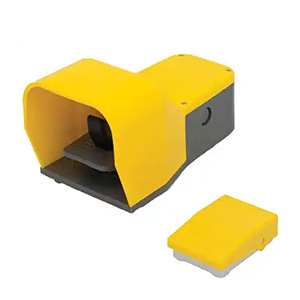
TER Omicron Industrial Footswitch
The TER Omicron Footswitch is a versatile industrial foot-operated control designed for the auxiliary control of machinery and equipment. Developed for demanding industrial environments, the Omicron provides operators with a practical method of controlling machine functions by foot while allowing the hands to remain available for positioning materials, operating other controls or performing associated work tasks.
Designed and manufactured by TER, the Omicron range combines rugged mechanical construction with flexible switching configurations and multiple operating modes. The footswitch can be configured for a wide variety of industrial applications, including machine tools, automation systems, assembly lines, shearing and bending machinery, wrapping equipment, lathes, riveters, plastic injection machines, printing machinery, strapping machines and other compatible equipment.
The Omicron range is available in single-foot, double-foot and compact mini-foot switch configurations, allowing the product to be selected according to the number of required control functions, available installation space and operating environment.
Five different pedal operating modes provide additional flexibility, ranging from simple free pedal movement through to locking, latching and two-stage operating arrangements. Covered versions can also incorporate positive-opening normally closed contacts for appropriate safety-related control functions.
With rugged materials, multiple switch arrangements and environmental protection up to IP65 depending on configuration, the TER Omicron provides a highly adaptable foot-operated control platform for industrial machine applications.
Industrial Foot Control for Machinery and Equipment
Foot-operated controls are widely used throughout industrial machinery because they allow an operator to initiate or control a machine function without removing their hands from the work area or another control device.
This can be particularly useful when an operator needs both hands to position a component, guide material, hold a workpiece or perform another operation while simultaneously controlling a machine function.
The TER Omicron has been designed specifically for this type of auxiliary machine control. Rather than being limited to one particular machine type, the range provides several mechanical and electrical configurations that allow it to be adapted to different control requirements.
The Omicron is an electromechanical control device intended for low-voltage control circuits. Operation of the pedal mechanically actuates the internal switch or switches, allowing the footswitch to provide the required electrical switching function within a correctly designed machine control system.
Designed for Demanding Industrial Environments
Industrial footswitches can be exposed to considerably harsher operating conditions than conventional panel-mounted switches. Their position near floor level means they may encounter dust, dirt, moisture, debris and repeated mechanical operation throughout the working life of a machine.
The TER Omicron has been developed with these conditions in mind. Depending on the selected configuration, the footswitch incorporates shock-resistant ABS, self-extinguishing polycarbonate/ABS-V0 or die-cast aluminium within its construction.
The materials and components are designed to provide resistance to shock and wear, supporting reliable operation in demanding industrial environments.
The covered Omicron configuration provides IP65 protection, while the compact mini-foot switch is classified IP40. This distinction allows users and machine designers to select the appropriate configuration according to the environmental conditions of the intended installation.
Single Omicron Footswitch Configuration
The single TER Omicron Footswitch provides one primary foot-operated control position. This configuration is suitable for machinery requiring a dedicated foot command where one pedal can perform the required operating function.
A single-foot control can provide a compact and straightforward interface between the operator and machine control circuit. Depending on the selected Omicron configuration, different pedal operating modes and switch arrangements can be specified to match the requirements of the machine.
The protected pedal arrangement of the covered Omicron also helps provide a defined operating area around the foot control while protecting the internal switching mechanism.
Double Omicron Footswitch Configuration
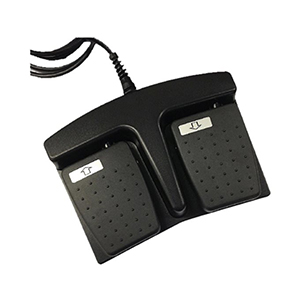
For machinery requiring two foot-operated functions, the Omicron is also available as a double footswitch.
A double configuration allows two pedal controls to be incorporated into a common operating assembly. This can provide a practical solution where two related machine commands need to be accessible to the operator without requiring two completely independent footswitch assemblies.
The exact operating functions assigned to each pedal depend on the machine and its control system. The flexibility of the Omicron range allows machine designers to select suitable switching and operating arrangements for the intended application.
Compact Omicron Mini-Footswitch
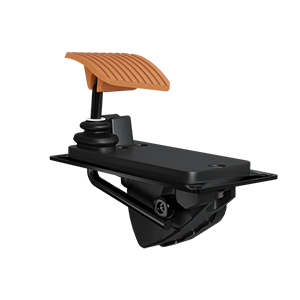
TER also offers the Omicron in a mini-foot switch configuration for applications where compact dimensions are particularly important.
The mini-foot switch provides the fundamental benefits of foot-operated machine control in a smaller package, making it suitable for installations where available floor space or equipment packaging is restricted.
The mini configuration differs technically from the covered Omicron and should be selected according to the requirements of the application. The mini-foot switch provides an IP40 protection rating, compared with IP65 for the covered version.
The mini-foot switch also has an operating angle from approximately 2 to 4 degrees, while the covered Omicron provides a larger operating angle of approximately 15 degrees.
Five Different Pedal Operating Modes
One of the most important characteristics of the TER Omicron range is the availability of five different pedal operating modes. This allows the mechanical behaviour of the footswitch to be matched more closely to the required machine function.
Different applications can require very different pedal behaviour. Some machines may require immediate actuation whenever the operator presses the pedal, while others may benefit from a neutral locking mechanism, maintained low-position operation or a two-stage control sequence.
By providing several operating modes within the Omicron platform, TER allows machine manufacturers and system designers to select a configuration suited to the intended control philosophy rather than adapting one universal pedal mechanism to every application.
Free Movement Pedal Operation
The free movement configuration provides straightforward pedal actuation without an additional neutral locking mechanism.
When the operator applies the required foot movement, the pedal travels through its operating range and actuates the associated switch according to the selected configuration.
This type of arrangement is suitable for applications where uncomplicated foot operation is required and where additional mechanical protection against pedal movement is not part of the machine control strategy.
Pedal Locked in the Neutral Position
The Omicron can also be configured with the pedal locked in its neutral position. In this arrangement, an additional mechanical action is required before the pedal can be operated.
This can help reduce the likelihood of unintended pedal movement caused by accidental contact with the footswitch. Such functionality can be valuable where the machine designer requires a deliberate operator action before pedal actuation can occur.
The use of a neutral locking mechanism should be considered as part of the complete machine control and risk assessment process rather than treated as a substitute for other required machine safety measures.
Pedal Latched in the Low Position
Another available Omicron configuration allows the pedal to be latched in the low position.
This arrangement can be useful where the machine function requires the footswitch to remain in an actuated position without continuous foot pressure from the operator.
The suitability of a latching arrangement depends heavily on the intended machine function. Machine designers should therefore select this configuration only where maintained operation is appropriate to the control strategy and applicable safety requirements.
Two-Stage Pedal Operation
The TER Omicron is also available with free pedal movement combined with two-stage actuating force.
A two-stage pedal provides two distinct operating regions within the pedal movement. This can allow different switching functions or control states to be associated with different stages of pedal travel, depending on the selected electrical configuration.
Two-stage operation can provide a more sophisticated operator interface than a conventional single-stage footswitch, making it useful for machinery requiring sequential or differentiated foot-operated commands.
Neutral Locking with Two-Stage Operation
The fifth Omicron operating arrangement combines neutral-position locking with two-stage actuating force.
This configuration combines deliberate release of the pedal from its neutral position with the additional functionality provided by two-stage operation.
For suitable applications, this can provide greater control over how and when the pedal is actuated while still allowing multiple stages of foot-operated control.
The final configuration should always be selected according to the requirements of the machine, its control circuit and the applicable risk assessment.
Positive-Opening Normally Closed Contacts
Covered versions of the TER Omicron can incorporate positive-opening normally closed contacts for safety functions. This feature is not available on the mini-foot switch configuration.
Positive-opening operation provides a defined mechanical relationship between movement of the actuator and opening of the normally closed contact. This characteristic is particularly relevant where the switch forms part of an appropriately designed safety-related control function.
The presence of positive-opening contacts does not by itself make an entire machine or control circuit safe. The complete system must be designed and validated according to the applicable machinery safety requirements.
However, the availability of positive-opening NC contacts provides machine designers with an important option when selecting components for compatible control and safety functions.
1NO and 1NC Contact Configuration
The Omicron can be equipped with one or two switches featuring 1NO+1NC contacts, with slow-action or snap-action switching available depending on configuration.
The combination of normally open and normally closed contacts provides considerable flexibility when designing industrial control circuits. A normally open contact can be used to establish a circuit when the pedal reaches the switching position, while a normally closed contact can provide the complementary switching state.
The exact wiring arrangement and function should be determined by the machine designer according to the required control logic and selected Omicron switch configuration.
Slow-Action Switching
Slow-action switches change contact state according to the mechanical movement of the actuator rather than relying on the rapid transition associated with a snap-action mechanism.
This type of switching can be appropriate for particular industrial control arrangements where the relationship between pedal movement and contact operation is an important part of the control design.
The Omicron platform allows slow-action switching to be selected where it best matches the electrical and mechanical requirements of the machine.
Snap-Action Switching
Snap-action switching provides a rapid transition between contact states once the switching point has been reached.
This characteristic can provide clearly defined electrical switching behaviour and is widely used in industrial control applications.
By offering both slow and snap-action alternatives, the TER Omicron provides additional flexibility for equipment manufacturers and control system designers.
Optional Mushroom Pushbutton
The TER Omicron can also be supplied with a mushroom pushbutton on request, depending on the selected configuration.
This provides machine manufacturers with the ability to integrate an additional operator control into the footswitch assembly where appropriate.
The specific function assigned to the mushroom pushbutton depends on the machine control design and selected product configuration. Where a mushroom control is intended to perform a safety-related function, the complete installation must be assessed against the relevant machine safety requirements.
Multiple Cover Colour Options
The Omicron is available with different cover colours, including grey, yellow and red. This provides additional flexibility when integrating the footswitch into different machine designs or control identification systems.
Colour can assist with visual identification of control equipment, although colour alone should not be relied upon to define the function or safety status of a control.
Machine designers should select the appropriate cover colour together with the required operating mode, switch configuration and mechanical construction.
Shock-Resistant ABS Construction
Depending on the selected version, the Omicron base, cover and pedal can be manufactured from shock-resistant ABS material.
ABS is widely used for industrial equipment housings because it provides a useful combination of mechanical durability, impact resistance and relatively low weight.
For a floor-mounted operator control, resistance to impact and repeated mechanical use is particularly important because the device may be exposed to accidental contact, footwear and general industrial activity around the machine.
Self-Extinguishing Polycarbonate and ABS-V0 Construction
TER also offers Omicron configurations using self-extinguishing polycarbonate/ABS-V0 material.
This material option provides an alternative construction for applications where the specified material properties are appropriate to the machine design.
The use of industrial-grade housing materials contributes to the Omicron’s ability to withstand repeated use and challenging operating conditions.
Die-Cast Aluminium Cover Option
For applications requiring a metal cover, the Omicron can also be configured with a die-cast aluminium cover combined with a base and pedal manufactured from self-extinguishing polycarbonate/ABS-V0.
The availability of different construction options allows OEMs and machine builders to select an Omicron configuration according to the mechanical and environmental requirements of their equipment.
This flexibility is particularly valuable when a common footswitch family needs to be applied across several machine types or operating environments.
IP65 Protection for Covered Omicron Footswitches
The covered TER Omicron Footswitch provides an IP65 protection rating. This makes it particularly suitable for industrial environments where the footswitch may be exposed to dust and water.
An IP65 rating provides dust-tight protection and protection against water jets under the conditions defined by the applicable ingress protection standard.
Because footswitches are normally positioned close to floor level, environmental protection can be especially important. Dust, debris and moisture can accumulate in areas where industrial machinery operates, making appropriate enclosure protection an important consideration when selecting a foot control.
IP40 Protection for the Mini-Footswitch
The Omicron mini-foot switch is rated IP40. This differs significantly from the IP65 rating of the covered configuration and should be considered when determining which version is appropriate for an installation.
The mini-foot switch is therefore better suited to applications where its compact dimensions are required and the environmental conditions are compatible with its lower ingress protection rating.
Machine designers should not assume that the IP65 rating of the covered Omicron automatically applies to every product within the Omicron family.
Wide Industrial Operating Temperature Range
The TER Omicron is designed to operate across a temperature range from -25°C to +70°C, supporting use in a wide variety of industrial environments.
The specified storage temperature range extends from -30°C to +80°C.
This broad temperature capability is valuable for equipment that may be installed in unconditioned factories, warehouses, workshops or other industrial facilities where ambient temperature can vary considerably.
Shock Resistance for Covered Configurations
The covered Omicron is specified for shock resistance of 50 g using a half-sinusoidal shock of 11 milliseconds without a change in contact position.
This characteristic supports the use of the footswitch in industrial machinery where vibration, impact or other mechanical disturbances may occur during operation.
Maintaining the intended contact state during mechanical shock is important for reliable machine control, particularly in environments containing heavy equipment or repeated mechanical movement.
Different Operating Characteristics for Each Omicron Configuration
The mini and covered Omicron footswitches have different mechanical operating characteristics.
The mini-foot switch has a specified operating torque of 1.2 Nm and an operating angle between approximately 2 and 4 degrees. The covered Omicron has a specified operating torque of 0.25 Nm and an operating angle of approximately 15 degrees.
These differences demonstrate why the Omicron should be treated as a configurable product family rather than a single universal footswitch specification.
Selecting the correct model requires consideration of the required pedal movement, operator interaction, environmental protection, switch arrangement and available installation space.
Designed for High-Cycle Industrial Operation
Industrial footswitches may be operated hundreds or thousands of times during a production shift, making mechanical durability an important selection consideration.
Depending on the switch and selected configuration, the Omicron range provides mechanical life ratings extending into the millions of operations, with TER specifying switch life up to a maximum of 30 million operations for applicable configurations.
This high-cycle capability makes the Omicron particularly relevant to repetitive industrial processes where dependable foot-operated control is required throughout extended production periods.
A Flexible Footswitch Platform for Machine Builders
The TER Omicron Footswitch provides machine manufacturers, automation specialists and system integrators with a highly configurable industrial foot-control platform.
Single, double and mini-foot switch versions allow the physical configuration to be matched to the machine, while five different pedal operating modes provide substantial flexibility in the way the operator interacts with the control.
Available 1NO+1NC slow or snap-action contacts, positive-opening NC contacts on applicable covered configurations, optional mushroom pushbutton arrangements and multiple construction materials further expand the range of possible configurations.
With covered versions offering IP65 environmental protection, a -25°C to +70°C operating temperature range and rugged industrial construction, the TER Omicron provides a strong foundation for reliable foot-operated auxiliary control across a wide variety of industrial machinery applications.
Electrical Performance of the TER Omicron Footswitch
The TER Omicron Footswitch combines a rugged mechanical pedal assembly with industrial switching components designed for low-voltage auxiliary machine control. The electrical characteristics vary between the compact mini-foot switch and the larger covered Omicron, allowing machine manufacturers and control system designers to select a configuration appropriate to the electrical, mechanical and environmental requirements of the application.
The covered Omicron provides AC15 and DC13 utilisation categories together with a range of rated operational currents for alternating-current and direct-current control circuits. The mini-foot switch uses a different electrical configuration and should therefore be evaluated independently rather than assuming that the electrical ratings of the covered version apply across the complete Omicron range.
This distinction is particularly important when specifying a footswitch for new machinery or replacing an existing industrial control. The required utilisation category, operational voltage, current, contact arrangement, mechanical life and environmental protection should all be confirmed for the selected Omicron configuration.
AC15 and DC13 Utilisation Categories
The covered TER Omicron Footswitch is specified for AC15 and DC13 utilisation categories. These categories are commonly associated with electromagnetic control loads used within industrial control systems.
AC15 applies to the control of electromagnetic loads in alternating-current circuits, while DC13 applies to electromagnetic loads in direct-current circuits. These classifications provide machine designers with more meaningful information than a simple maximum voltage or current value because switching capability depends on the electrical characteristics of the connected load.
When selecting an Omicron footswitch, the utilisation category and rated operational current should therefore be checked against the actual control circuit rather than selecting the switch solely according to system voltage.
AC15 Rated Operational Current
For covered Omicron configurations, TER specifies several AC15 operational ratings to support different industrial control voltages.
The published ratings include 10 A at 24 Vac, 6 A at 240 Vac and 4 A at 400 Vac under AC15 utilisation conditions.
These different values demonstrate how the permissible operational current changes according to the voltage and electrical load characteristics. Machine designers should use the rating corresponding to the actual application and verify the requirements of the connected control equipment.
The Omicron should be incorporated into an appropriately designed control circuit rather than used outside its specified electrical ratings.
DC13 Rated Operational Current
The covered Omicron also supports DC13 control applications. TER specifies ratings including 6 A at 24 Vdc, 0.55 A at 125 Vdc and 0.4 A at 250 Vdc.
The reduction in permissible current at higher DC voltages reflects the more demanding switching characteristics associated with direct-current electromagnetic loads.
These ratings provide system designers with several options when integrating the Omicron into DC control architectures, but the specific operating voltage and current of the circuit must be confirmed before selecting or installing the footswitch.
A600 and Q600 Ratings
The covered Omicron is also specified with A600 and Q600 ratings according to UL508 and CSA C22-2 No. 14.
These ratings provide additional reference information for the switching capability of the device within applicable industrial control environments. A600 relates to AC control circuit applications, while Q600 relates to DC control circuit applications.
For machinery intended for particular markets or installations, the complete certification and marking requirements should be confirmed for the specific Omicron configuration being supplied.
Mini-Footswitch Electrical Ratings
The compact Omicron mini-foot switch has different electrical specifications from the covered version. TER specifies a rated operational current of 3 A at 250 Vac and 0.06 A at 230 Vdc for the mini-foot switch.
These values should not be confused with the higher AC15 and DC13 ratings published for the covered Omicron.
The difference reinforces the importance of treating the mini and covered versions as separate configurations within the Omicron family. Although both provide foot-operated machine control, their electrical, environmental and mechanical characteristics are not identical.
Rated Insulation Voltage
The rated insulation voltage provides another important distinction between Omicron configurations.
The mini-foot switch has a rated insulation voltage of 250 V, while the covered Omicron has a rated insulation voltage of 690 V at pollution degree 3.
Pollution degree 3 is relevant to industrial environments where conductive pollution may occur or where dry non-conductive contamination can become conductive as a result of condensation.
The higher insulation specification of the covered Omicron supports its use within demanding industrial control environments, subject to correct installation and compliance with the requirements of the complete electrical system.
Rated Impulse Voltage
The mini-foot switch has a rated impulse voltage of 1 kV, while the covered Omicron is rated at 6 kV.
Rated impulse voltage relates to the ability of the electrical insulation system to withstand transient overvoltage conditions within its specified application.
This is another important specification for machine builders and electrical designers when determining whether a particular Omicron configuration is appropriate for the intended control system.
Conventional Free-Air Thermal Current
TER specifies the conventional free-air thermal current at an ambient temperature below 40°C as 15 A for the mini-foot switch and 10 A for the covered Omicron.
This thermal-current rating should not be confused with the rated operational current for a particular utilisation category. Operational switching capability depends on factors including voltage, load type and utilisation category.
Both sets of specifications should therefore be considered when designing the electrical control circuit.
Contact Resistance
The electrical contacts within an industrial footswitch need to provide reliable switching over a large number of operating cycles. TER specifies contact resistance of approximately 30 mΩ for the mini-foot switch and 25 mΩ for the covered Omicron configuration.
Low contact resistance helps support reliable electrical continuity when the switch contacts are closed.
Contact condition should nevertheless be considered throughout the service life of the machine, particularly where the footswitch is subjected to very high operating cycles or electrical loads approaching its specified ratings.
Short-Circuit Protection
For the covered Omicron, TER specifies short-circuit protection using a 10 A gG-type fuse for applications below 500 Vac.
Correct protective devices are an important part of the overall electrical installation. A footswitch should not be considered an independent protection device for the complete machine circuit.
Overcurrent and short-circuit protection should be designed according to the footswitch specification, connected equipment and applicable electrical requirements.
1NO+1NC Contact Arrangement
The covered Omicron can be equipped with one or two switches featuring 1NO+1NC contacts. This provides one normally open and one normally closed contact associated with the switching mechanism.
Having both contact states available provides flexibility when designing machine-control logic. The normally open contact can be used to establish a circuit following pedal actuation, while the normally closed contact can provide a complementary switching state.
The actual function assigned to each contact depends on the machine control design and selected operating mode.
Positive-Opening Normally Closed Contacts
A significant feature of applicable covered Omicron configurations is the use of positive-opening normally closed contacts. TER specifies that the NC contacts of the covered configuration are of the positive-opening operation type.
Positive-opening operation creates a direct mechanical relationship between movement of the switching mechanism and opening of the normally closed contact. This differs from switching arrangements that rely solely on spring action to separate the contacts.
This characteristic is important when the switch is selected for appropriate safety-related control functions. However, the use of a positive-opening contact does not independently establish the safety performance of the complete machine.
The entire safety function must be designed, assessed and validated according to the applicable machinery safety requirements.
Positive Opening and the Mini-Footswitch
TER specifically notes that positive-opening NC contacts for safety functions are not available for the mini-foot switch configurations.
This is an important distinction when selecting between the compact mini version and the covered Omicron.
If the machine control strategy requires a positive-opening normally closed contact, an appropriate covered configuration should be selected rather than assuming that the compact Omicron provides equivalent functionality.
Snap-Action Switch Configuration
The Omicron range can incorporate snap-action switching. A snap-action mechanism changes contact state rapidly once the operating mechanism passes its defined switching point.
This provides a distinct transition between electrical states and can be beneficial in industrial control applications where clearly defined switching behaviour is required.
Snap-action switching can be combined with the appropriate Omicron mechanical pedal configuration to create a foot-operated control suited to the requirements of the machine.
Slow-Action Switch Configuration
Slow-action switching is also available within the Omicron range. With a slow-action mechanism, contact movement is more directly related to the movement of the mechanical actuator.
This provides different switching behaviour from a snap-action device and may be preferable for certain machine control or safety-related arrangements.
The choice between slow and snap-action switching should be made according to the required electrical behaviour, pedal operating mode and control-system architecture.
One or Two Internal Switches
The covered Omicron can be configured with one or two switches, providing additional flexibility for machine builders.
A single-switch configuration can be appropriate where one contact set is sufficient for the required machine function. A two-switch configuration can support applications requiring additional switching states or more complex pedal-control sequences.
This flexibility becomes particularly valuable when combined with the Omicron’s available two-stage pedal operating modes.
Two-Stage Footswitch Control
TER offers Omicron configurations with two-stage actuating force. This allows the pedal to provide two distinct stages of operator input within its movement.
A two-stage footswitch can be useful where the machine requires different control actions according to the degree of pedal travel. The first stage can provide one defined switching action, while additional pedal movement can initiate another state according to the selected configuration and machine-control design.
The precise function of each stage is determined by the electrical configuration and the way the footswitch is integrated into the machinery.
Two-Stage Operation with Neutral Locking
Two-stage actuation can also be combined with a pedal that is locked in the neutral position.
This arrangement requires a deliberate operator action to release the pedal before the two-stage control sequence can be accessed.
For machinery where inadvertent pedal movement needs to be reduced, this mechanical arrangement can provide an additional layer of deliberate operator interaction.
The suitability of this configuration should always be established through the overall machine risk assessment and control-system design.
High Mechanical Life for Repetitive Applications
The TER Omicron is designed for repetitive industrial operation. Mechanical life varies according to configuration, with TER specifying 10 million operations for the mini-foot switch and up to 30 million operations for the covered Omicron switch arrangement.
This high mechanical endurance is particularly valuable in automated production, assembly and machine-tool applications where a footswitch may be actuated repeatedly throughout every working shift.
Over the service life of industrial machinery, even relatively simple operator controls can accumulate millions of operating cycles. Selecting a footswitch designed for high-cycle operation can therefore help reduce maintenance requirements and unplanned replacement.
30 Million Operation Capability
The covered Omicron can achieve a mechanical life of up to 30 million operations depending on the selected switch and configuration.
This makes the Omicron particularly attractive for repetitive machine processes where foot operation forms a regular part of the production cycle.
Actual service life in an installation will depend on operating conditions, electrical loading, mechanical configuration, environmental exposure and maintenance.
10 Million Operations for the Mini-Footswitch
The mini-foot switch is specified for a mechanical life of 10 million operations.
Although lower than the maximum rating of the covered Omicron, this still provides substantial mechanical endurance for a compact industrial foot control.
The mini version can therefore provide an effective solution where space is limited and the lower IP40 environmental protection and mini-foot switch electrical characteristics are appropriate to the application.
Electrical Connections on the Mini-Footswitch
The mini Omicron uses M3 x 0.5 screw connections with a Phillips-head arrangement and washer.
Screw-type electrical connections provide a conventional method of terminating conductors within industrial control equipment.
Installation should ensure that conductors are correctly prepared and secured and that wiring is protected from strain, abrasion and movement.
Electrical Connections on the Covered Omicron
The covered Omicron uses M3.5 screw terminals with cable-clamping arrangements. TER specifies conductor accommodation of one or two conductors from 0.75 mm² to 2.5 mm² for the applicable configuration.
This provides flexibility when integrating the footswitch into industrial machine wiring systems.
Correct conductor sizing should be determined according to the control circuit, electrical load, installation method and applicable wiring requirements rather than simply using the largest conductor accepted by the terminal.
M20 Cable Entry on Covered Versions
The covered TER Omicron uses an M20 cable gland entry.
The cable gland forms an important part of the installation because it provides the interface between the external machine wiring and the protected footswitch enclosure.
Correct cable and gland selection is particularly important where the IP65 environmental protection of the covered Omicron needs to be maintained after installation.
The cable gland should be appropriate to the cable diameter, environmental conditions and installation requirements.
Cable Entry on the Mini-Footswitch
The mini-foot switch uses a cable gland arrangement suitable for cable diameters up to approximately 8.5 mm, with TER identifying a 6 mm entry specification within the general technical data.
As with the covered configuration, cable selection and termination should be appropriate to the electrical and mechanical requirements of the application.
The lower IP40 protection rating of the mini-foot switch should also be considered when determining where the control can be installed.
IP65 Protection for the Covered Omicron
The covered Omicron provides IP65 environmental protection, supporting installation in industrial areas where dust and water exposure may occur.
IP65 protection provides dust-tight enclosure performance and protection against water jets under the applicable test conditions.
This level of protection is particularly useful for a foot-operated device because floor-level controls can be more exposed to contamination than controls installed on protected electrical panels.
IP40 Protection for the Mini Omicron
The mini Omicron is rated IP40 and therefore provides a different level of environmental protection from the covered footswitch.
This configuration is better suited to protected environments where the compact size of the mini-foot switch provides a greater advantage than the higher ingress protection of the covered version.
Environmental exposure should be assessed carefully before selecting the mini configuration.
Salt-Mist Resistance
TER specifies salt-mist resistance for the covered Omicron configuration. This characteristic can be valuable for machinery operating in environments where corrosive atmospheric conditions may be present.
Applications near coastal environments, certain industrial processes and equipment exposed to challenging atmospheric conditions can place additional demands on electrical and mechanical components.
Salt-mist resistance complements the robust materials and IP65 protection of the covered Omicron.
50 g Shock Resistance
The covered Omicron is specified to withstand a 50 g half-sinusoidal shock lasting 11 milliseconds without a change in contact position.
This specification is significant for industrial machinery because mechanical shock can occur through machine operation, movement of equipment, impact or vibration transmitted through the installation area.
Maintaining the intended contact position during a defined shock event supports dependable operation of the control circuit.
Operating Torque of the Covered Omicron
The covered Omicron has a specified operating torque of 0.25 Nm.
This contributes to the pedal feel and the amount of operator effort required to move the control through its operating range.
Pedal effort is an important ergonomic consideration for repetitive applications because an operator may actuate the footswitch many times during a working shift.
Operating Torque of the Mini Omicron
The mini-foot switch has a specified operating torque of 1.2 Nm.
This differs significantly from the covered Omicron and reflects the different mechanical construction and operating geometry of the compact control.
Machine designers should therefore consider operator feel and required actuation characteristics as well as physical size when choosing between the mini and covered versions.
Pedal Operating Angle
The covered Omicron provides approximately 15 degrees of pedal operating angle, while the mini-foot switch operates through approximately 2 to 4 degrees.
The larger movement of the covered version provides a different operator experience from the short travel of the mini configuration.
Available space, required pedal movement, operating frequency and operator ergonomics should all be considered when selecting the appropriate version.
Operating Temperature from -25°C to +70°C
Both Omicron configurations are designed for operation across an ambient temperature range from -25°C to +70°C.
This allows the footswitch to support machinery installed across a broad range of industrial environments, including workshops, manufacturing facilities, warehouses and other locations that may not have tightly controlled ambient temperatures.
The specified storage temperature range extends from -30°C to +80°C.
Material Options for Industrial Environments
TER offers the Omicron with several material configurations to support different machine requirements.
Depending on the selected version, the base, cover and pedal can be manufactured from shock-resistant ABS or self-extinguishing polycarbonate/ABS-V0. A die-cast aluminium cover is also available in combination with a self-extinguishing polycarbonate/ABS-V0 base and pedal.
These material choices allow equipment designers to balance mechanical durability, environmental requirements and machine construction preferences.
Shock and Wear Resistant Components
TER specifies that the materials and components used in the Omicron are resistant to shock and wear.
This is particularly relevant to foot-operated industrial controls because the pedal and enclosure are exposed to repeated mechanical interaction throughout their working life.
Durable construction helps the footswitch maintain its mechanical function in repetitive production environments and contributes to the long mechanical life available from the Omicron range.
Choosing Between Mini and Covered Omicron Footswitches
The mini-foot switch and covered Omicron should be selected according to the specific requirements of the machine rather than treated as interchangeable versions.
The mini configuration offers compact dimensions, IP40 protection, a 250 V rated insulation voltage, 1 kV impulse rating, 15 A conventional free-air thermal current and a mechanical life of 10 million operations.
The covered Omicron provides IP65 protection, AC15 and DC13 utilisation categories, a 690 V rated insulation voltage at pollution degree 3, 6 kV impulse rating, 10 A conventional free-air thermal current and mechanical life up to 30 million operations depending on configuration.
The covered version can also provide positive-opening normally closed contacts, multiple pedal operating modes, enhanced environmental protection and configurations suited to more demanding industrial machine-control requirements.
Flexible Electrical Control for Industrial Machinery
The TER Omicron Footswitch provides machine builders with considerable flexibility by combining multiple mechanical pedal arrangements with a comprehensive selection of industrial switching characteristics.
Available AC15 and DC13 ratings allow covered versions to support a range of AC and DC control circuits, while 1NO+1NC contacts and slow or snap-action switching provide options for different control architectures.
Positive-opening NC contacts on applicable covered configurations provide an additional option for appropriately engineered safety-related control functions, while two-stage pedal mechanisms enable more sophisticated operator commands where required.
Combined with IP65 protection, salt-mist resistance, high shock resistance, rugged material options and a mechanical life of up to 30 million operations, the covered TER Omicron provides a durable foot-operated interface for demanding industrial machine applications.
For applications where compact dimensions are the priority, the Omicron mini-foot switch provides an alternative solution with IP40 protection and a mechanical life of 10 million operations. Together, these configurations allow the Omicron range to address a broad spectrum of industrial foot-control requirements while maintaining the flexibility required by modern machine builders and automation specialists.
Industrial Applications for the TER Omicron Footswitch
The TER Omicron Footswitch is designed to provide reliable foot-operated auxiliary control across a wide range of industrial machinery and equipment. By allowing machine functions to be initiated or controlled using the foot, the Omicron enables operators to keep their hands available for positioning components, handling materials, operating other controls or performing associated production tasks.
This combination of hands-free operation, rugged construction and flexible switching configurations makes the Omicron particularly suitable for industrial applications where repetitive operator input is required. Single, double and mini-foot switch configurations provide different installation possibilities, while five available pedal operating modes allow the mechanical behaviour of the control to be matched to the requirements of the machine.
TER identifies applications including automation and assembly lines, machine tools, crane control cabins, plastic injection machinery, printing machines, strapping machinery and medical equipment. The Omicron is also specifically designed for auxiliary control of machinery including shearing, bending and wrapping machines, lathes and riveters.
Automation and Assembly Line Applications
Modern automated and semi-automated production systems frequently require operators to interact with machinery while simultaneously handling components or materials. A foot-operated control can provide an effective solution by transferring selected machine commands from the hands to the feet.
The TER Omicron can be integrated into compatible low-voltage machine control circuits to provide this type of auxiliary operator input. Depending on the configuration, pedal operation can actuate one or more switches and provide the electrical contact states required by the machine control system.
For repetitive assembly processes, the Omicron’s high mechanical endurance is particularly valuable. Covered configurations can provide a mechanical life of up to 30 million operations depending on the selected switch, supporting applications where the footswitch may be actuated repeatedly throughout production shifts.
Machine Tool Control
Machine tools represent another important application area for industrial footswitches. Operators working with machine tools may need to position a workpiece or manipulate tooling while controlling an auxiliary machine function.
A correctly integrated Omicron Footswitch allows selected commands to be operated by foot, leaving the operator’s hands available for other tasks. TER specifically identifies machine tools among the intended applications for the Omicron range.
Available operating modes allow the machine designer to select pedal behaviour appropriate to the required function, including free movement, neutral-position locking, low-position latching and two-stage operation.
Shearing Machine Applications
TER identifies shearing machines as one of the types of machinery suitable for Omicron auxiliary control. In these applications, foot operation can provide a practical method of initiating an appropriately designed machine-control function while the operator’s hands remain available for handling or positioning material.
The specific footswitch configuration should be selected according to the control philosophy and risk assessment of the machine. Depending on the requirements, this may include a protected pedal, neutral-position locking or other operating characteristics intended to provide deliberate operator interaction.
Where a footswitch forms part of a safety-related control function, the complete safety system must be designed and validated according to the applicable machinery safety requirements.
Bending Machine Applications
Bending machinery can also benefit from foot-operated auxiliary control. Operators frequently need to position material accurately before and during a bending process, making it advantageous to keep both hands available where the machine design and operating procedure permit.
The Omicron can provide a dedicated foot-operated input to the machine’s low-voltage control circuit. Multiple pedal configurations allow the footswitch to be selected according to the required operating sequence and level of protection against unintended actuation.
For demanding industrial environments, the IP65 protection available on covered Omicron configurations provides additional resistance against dust and water ingress.
Wrapping and Packaging Machinery
Wrapping and other packaging machinery can require frequent operator interaction during loading, positioning and processing of products. Foot-operated controls can provide a useful auxiliary interface where an operator needs to control a function while continuing to handle the item being packaged.
The Omicron’s configurable switching arrangements allow it to be integrated into compatible packaging-machine control circuits. Depending on the selected version, one or two switches with 1NO+1NC contacts can be provided with slow or snap-action operation.
This gives machine manufacturers flexibility when developing the electrical control logic associated with pedal operation.
Strapping Machine Control
TER specifically identifies strapping machinery as an application for the Omicron Footswitch. In packaging and logistics environments, operators may need to position cartons, bundles or other items while initiating the strapping cycle or another associated machine function.
A foot-operated control can allow the operator to maintain control of the item with both hands while using the foot to provide the required auxiliary command.
For repetitive packaging operations, the mechanical durability of the Omicron can be especially valuable because the footswitch may experience a high number of operating cycles during normal production.
Riveting Machine Applications
Riveters are another machine type identified by TER for Omicron footswitch applications. Riveting operations can require an operator to hold and position components while initiating a machine function.
A foot-operated auxiliary control can provide an ergonomic method of separating the machine command from the operator’s hands.
The appropriate Omicron configuration should be determined according to the electrical control circuit, required pedal behaviour, operating environment and machine safety assessment.
Lathe Applications
TER also identifies lathes among the machinery that can use the Omicron for auxiliary control. Foot-operated controls can be useful for appropriate supplementary functions where the machine design requires an operator command independent from conventional panel-mounted controls.
As with any machine-tool application, the exact function of the footswitch should be determined by the equipment manufacturer or control-system designer. The Omicron provides the switching interface, while the overall machine control system determines how the resulting electrical command is processed.
Plastic Injection Machinery
Plastic injection machines are specifically listed by TER as an application area for the Omicron Footswitch. These machines can combine automated processes with manual component handling, setup and production operations.
A foot-operated control can provide an additional operator interface where hands-free actuation is beneficial to the production process.
The Omicron’s multiple configurations provide flexibility for machine manufacturers selecting the appropriate pedal mechanism, contact arrangement and environmental protection level for the installation.
Printing Machine Applications
Printing machinery is another application area identified by TER. Industrial printing processes can require operators to position materials, make adjustments and interact with machinery while maintaining control over specific auxiliary functions.
Footswitch operation can provide an efficient way to initiate suitable machine commands without requiring the operator to reach for another hand-operated control.
The availability of single and double Omicron configurations can also be valuable where one or two independent foot-operated functions are required within the operator workstation.
Crane Control Cabins
TER includes the Omicron among its control solutions for crane control cabins. Crane operator environments can incorporate multiple hand-operated controls, making foot-operated auxiliary commands useful for appropriate secondary functions.
A footswitch can provide an additional control input without occupying valuable space on joysticks or control panels. Depending on the application, this can help distribute operator functions between hand and foot controls.
The particular command assigned to the Omicron must be determined according to the crane design, control architecture and applicable safety requirements.
Medical Equipment Applications
TER also identifies medical equipment as an application area for the Omicron Footswitch. Foot-operated controls can be useful in equipment where an operator needs to keep both hands available while controlling an auxiliary electrical function.
The appropriate Omicron configuration should be selected according to the requirements of the equipment, environment and applicable standards. The footswitch itself should not be assumed to provide compliance for the complete medical system simply because TER identifies medical equipment as a potential application area.
The compact mini-foot switch may be particularly useful where installation space is limited and the IP40 environmental protection and electrical characteristics of the mini configuration are suitable for the intended equipment.
Hands-Free Machine Operation
One of the principal benefits of an industrial footswitch is the ability to move a suitable control function away from the operator’s hands.
In many production environments, the operator’s hands are already occupied with components, tools, materials or other control devices. Requiring the operator to release a workpiece simply to operate an auxiliary pushbutton can reduce efficiency and may make the workstation less ergonomic.
A footswitch can provide an alternative input method, allowing the hands and feet to perform different control tasks within a correctly designed workstation.
Operator Ergonomics and Pedal Selection
Operator ergonomics should be considered when selecting and positioning an industrial footswitch, particularly in applications involving repetitive operation.
The covered Omicron provides approximately 15 degrees of operating movement with a specified operating torque of 0.25 Nm. The mini-foot switch provides a shorter operating angle of approximately 2 to 4 degrees with a specified operating torque of 1.2 Nm.
These differences result in distinct operating characteristics and should be considered alongside available floor space, footwear, operator posture and expected operating frequency.
Single Footswitch Applications
A single Omicron Footswitch provides one dedicated pedal position and can be appropriate where only one foot-operated machine command is required.
This configuration can provide a simple operator interface while retaining access to the different pedal operating modes and switch configurations available within the Omicron family.
For many machine tools, packaging machines and assembly applications, a single pedal can provide the required auxiliary command without introducing unnecessary additional controls.
Double Footswitch Applications
Where two foot-operated commands are required, the double Omicron provides two pedal positions within the footswitch assembly.
This can reduce the need to install two completely independent footswitch units and can provide a more organised operator control station.
The functions assigned to each pedal should be clearly defined and designed to minimise the possibility of operator confusion or unintended operation.
Mini-Footswitch Applications
The mini Omicron provides a compact alternative for applications where space is restricted or where the larger protected enclosure of the covered Omicron is unnecessary.
Its IP40 rating means that it should be installed in an environment appropriate to that level of protection. It should not be selected on the assumption that it provides the same IP65 protection as the covered Omicron.
The mini version also differs in its electrical ratings, mechanical life and operating characteristics, making careful configuration selection important.
Preventing Unintended Pedal Operation
Depending on configuration, the Omicron can incorporate a mechanism that requires the safety device to be released before the pedal can move from its neutral position.
This type of arrangement can help reduce unintended pedal operation caused by accidental contact. It can be particularly valuable where the footswitch is located close to the operator’s normal working position or where inadvertent pedal movement could initiate an unwanted machine command.
TER’s maintenance instructions recommend periodically checking the integrity and operation of the safety device where fitted.
Two-Stage Operating Applications
Two-stage Omicron configurations provide an additional level of control by allowing two distinct operating stages within pedal movement.
This can be useful for machinery requiring sequential control states or differentiated commands according to pedal travel. The two-stage arrangement can be supplied with free pedal movement or combined with a safety device that must be released before pedal operation.
The actual function assigned to each stage depends on the machine control system and should be engineered specifically for the application.
Maintained Low-Position Operation
The Omicron can also be configured with a latching mechanism that maintains the pedal in its lowered position.
This configuration can be useful where a machine function needs to remain active without requiring the operator to maintain continuous foot pressure.
Because maintained operation may not be appropriate for every machine function, the suitability of this configuration should be established during machine design and risk assessment.
Selecting the Appropriate Omicron Configuration
Selecting the correct TER Omicron Footswitch requires more than simply choosing between a single and double pedal.
The machine designer should consider the required operating mode, number and type of switches, contact arrangement, environmental protection, electrical ratings, construction material, pedal behaviour and any requirement for positive-opening normally closed contacts.
The operating environment should also be assessed to determine whether the IP40 mini-foot switch or IP65 covered configuration provides the appropriate level of protection.
Electrical Integration
The Omicron is an electromechanical device designed for low-voltage control circuits. It should therefore be integrated into the machine’s electrical architecture according to the requirements of the selected switch configuration.
The footswitch should not be treated as though it were universally intended to switch the full power of the machine directly. Instead, it provides electrical switching within an appropriately designed control system.
The selected utilisation category, operational voltage and current should be verified against the characteristics of the connected control circuit.
Installation and Wiring Considerations
Correct installation is important to maintaining the performance and reliability of the TER Omicron Footswitch.
Wiring should be carried out with the electrical supply isolated and in accordance with the requirements of the machine control system. Conductors should be correctly terminated at the switch terminals and secured to prevent movement or strain.
TER specifically advises that the internal switches should not be removed from their housings during wiring. The switches can be wired in position, and unnecessary removal may result in malfunction of the footswitch.
Maintaining Cable Entry Protection
The cable entry is an important part of the complete installation, particularly for IP65 covered Omicron configurations.
The covered footswitch uses an M20 cable gland, while the mini configuration uses a different cable-entry arrangement. The gland should be correctly selected and tightened around the cable to provide secure strain relief and maintain the intended enclosure protection.
TER recommends checking that the cable clamp is securely fastened and that the cable sheath provides complete protection at the entry point.
Keeping the Pedal Area Clear
Because the Omicron operates at floor level, foreign objects can potentially interfere with pedal movement.
TER recommends removing chips, stones, rags and other objects that could prevent correct pedal operation. This is particularly relevant in machining and fabrication environments where swarf, offcuts and other debris can accumulate around equipment.
The area around the footswitch should remain clear so the operator can access and release the pedal without obstruction.
Routine Inspection of the Omicron Footswitch
Routine inspection can help identify mechanical or electrical issues before they interfere with machine operation.
TER recommends checking and tightening the screws that secure the cover, inspecting the cable clamp and ensuring that the cable sheath remains intact. The cover should also be checked for physical damage.
Where a pedal safety device is fitted, its condition and operation should be periodically checked to confirm that the mechanism continues to perform as intended.
Cleaning the TER Omicron
Correct cleaning practices help protect the materials and internal mechanisms of the Omicron.
TER recommends using compressed air at approximately 1 atmosphere together with a damp cloth for cleaning. Detergents and additives should not be used.
Oil, acids and solvents should also be avoided because contact with these substances may damage the equipment.
No Internal Greasing or Oiling Required
The internal moving components of the Omicron should not be greased or oiled during routine maintenance.
TER specifies that components subject to rubbing are provided with lifetime self-lubrication. Introducing additional lubricants can therefore interfere with the intended operation or materials of the footswitch.
Maintenance should follow the manufacturer’s instructions rather than applying conventional lubrication practices used for unrelated mechanical equipment.
Responding to Footswitch Malfunctions
TER recommends replacing the footswitch if a malfunction is detected.
Machine operators and maintenance personnel should not continue using a footswitch that exhibits abnormal switching, physical damage or unreliable pedal operation.
Changes to the components of the footswitch can invalidate the rating-plate information, product identification and warranty. Where replacement components are required, TER specifies the use of original replacement parts.
Positive-Opening Contacts for Appropriate Safety Functions
Applicable covered Omicron configurations provide positive-opening normally closed contacts that can be used for safety functions.
This provides machine designers with an important switching option where direct mechanical opening of an NC contact is required as part of the control architecture.
The mini-foot switch does not provide this positive-opening NC contact option. This distinction should be considered carefully where the footswitch is being selected for a safety-related function.
The safety performance of the complete machine remains dependent on the design, architecture, validation and integration of the entire safety system.
IP65 Protection for Demanding Industrial Areas
For industrial environments where dust and moisture exposure are significant considerations, the covered Omicron provides IP65 ingress protection.
This makes the covered version particularly attractive for machine tools, fabrication machinery, packaging equipment and other industrial applications where floor-level controls can encounter environmental contamination.
The integrity of the complete installed enclosure, including the cable entry and cover, should be maintained to preserve the intended level of environmental protection.
Durability for Repetitive Production
Industrial production equipment can place substantial demands on operator controls. A footswitch used during every machine cycle may accumulate a very large number of operations over its service life.
The Omicron is designed around these repetitive operating requirements. The mini-foot switch provides substantial mechanical endurance, while covered configurations can achieve up to 30 million mechanical operations depending on the selected switch arrangement.
This makes the Omicron particularly suitable for consideration in high-cycle manufacturing and production environments.
Advantages of the TER Omicron Footswitch
The TER Omicron combines operator convenience with a broad range of configuration options. Machine builders can select single, double or mini-foot switch arrangements and choose between five different pedal operating modes.
Available slow and snap-action switching, 1NO+1NC contact arrangements, positive-opening NC contacts on applicable covered versions and optional mushroom pushbutton configurations provide further flexibility.
The covered Omicron adds IP65 environmental protection, robust material choices, resistance to mechanical shock and a mechanical life of up to 30 million operations depending on configuration.
This combination enables the Omicron platform to address a wide range of industrial foot-control requirements without forcing machine designers to adopt one universal pedal arrangement.
TER Footswitch Technology for Machine Builders
The Omicron forms part of TER’s range of foot-operated auxiliary controls for industrial machinery. Its configurable design allows OEMs, machine builders and automation specialists to select a footswitch according to the actual mechanical, electrical and environmental requirements of the equipment.
This is particularly valuable where one machine family contains several models or configurations. Different Omicron versions can potentially be selected according to the number of required pedals, operating mode, switching arrangement and installation environment.
TER Omicron Footswitch from Control Devices
Control Devices supplies specialised industrial control, sensing and operator interface products for machinery, automation and equipment applications. The TER Omicron Footswitch expands this offering with a versatile foot-operated control designed for industrial machine applications.
With single, double and mini-foot switch options, five pedal operating modes, multiple switch configurations and covered versions providing IP65 protection, the Omicron can be configured for a broad range of auxiliary machine-control requirements.
Control Devices can assist customers with product selection and technical information to help identify the TER Omicron configuration best suited to the electrical, mechanical and environmental requirements of an application.
Why Choose the TER Omicron Industrial Footswitch?
The TER Omicron provides an extensive combination of configuration flexibility, industrial durability and operator-focused control within one footswitch family.
Its single, double and mini configurations allow the physical design to be matched to available space and required machine functions. Five different pedal operating modes allow further customisation according to the desired operator interaction, including free movement, neutral locking, low-position latching and two-stage operation.
Covered Omicron versions provide IP65 protection, positive-opening NC contacts on applicable configurations, AC15 and DC13 switching capabilities and robust construction using shock-resistant ABS, self-extinguishing polycarbonate/ABS-V0 or die-cast aluminium depending on configuration.
The combination of high mechanical endurance and a -25°C to +70°C operating temperature range further supports use across demanding industrial environments.
Reliable Foot-Operated Auxiliary Machine Control
The TER Omicron Footswitch provides machine builders, OEMs and automation specialists with a flexible method of incorporating foot-operated auxiliary commands into industrial equipment.
By transferring appropriate machine-control functions to the foot, the Omicron can allow operators to keep their hands available for material handling, component positioning and other production tasks.
Its extensive range of pedal operating modes and switch configurations allows the control to be tailored to different machinery requirements, while covered versions provide the environmental protection and mechanical durability required for demanding industrial installations.
From automation and assembly lines to machine tools, plastic injection machines, printing equipment, strapping machinery, crane control cabins and other compatible industrial applications, the TER Omicron provides a versatile platform for dependable foot-operated control.
With configurable switching, rugged construction, high mechanical endurance and multiple protection and operating options, the TER Omicron Industrial Footswitch offers a practical and adaptable solution for modern industrial machinery and operator control systems.